

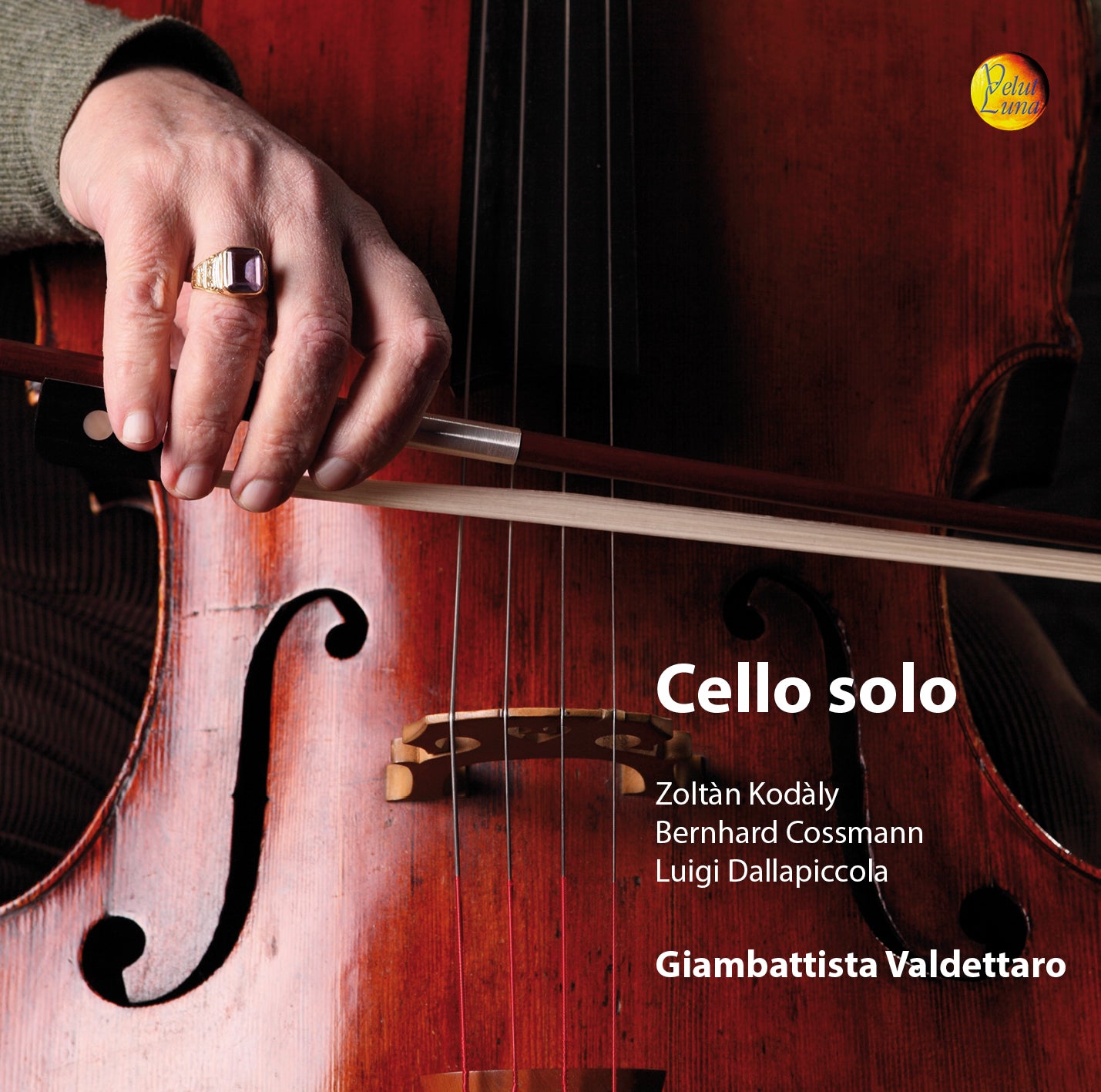
CELLO SOLO - Giambattista Valdettaro
CELLO SOLO - Giambattista Valdettaro
Velut Luna
Music genre: Folk
In stock
Couldn't load pickup availability
SKU:CVLD250
CELLO SOLO - Giambattista Valdettaro ( CVLD250 )
Authors : Zoltan Kodali; Bernhard Cossmann; Luigi Dallapiccola
Performer : Giambattista Valdettaro
Available in: HD File
Traces
01 - Zoltan Kodaly: Sonata op 8 - Allegro maestoso, ma passione
02 - Zoltan Kodaly: Sonata op 8 - Adagio
03 - Zoltan Kodaly: Sonata op 8 - Allegro molto vivace
04 - Bernhard Cossmann: Concert Study in C major, op. 10, no. 3
05 - Luigi Dalla Piccola: Chaconne
06 - Luigi Dalla Piccola: Interlude
07 - Luigi Dalla Piccola: Adagio
Notes
"GIAMBATTISTA VALDETTARO"
He began studying the cello in Verona, his hometown, under the guidance of Cesare Bonzanini (one of Camillo Oblach's most illustrious students) and continued with Benedetto Mazzacurati, graduating with top marks and honors from the "San Pietro a Majella" Conservatory in Naples. He subsequently furthered his studies in Naples with Willy La Volpe and in Zurich with Pierre Fournier.
He began his career in 1965 with a tour of the USA and Canada as principal cello with the "San Pietro a Majella" chamber orchestra conducted by Renato Ruotolo, also playing a solo role.
As a soloist and in various chamber ensembles, he has also performed throughout Europe and Italy. As a soloist with orchestras, he has performed with conductors such as Gabriele Gandini, Umberto Cattini, Angelo Campori, Wolfgang Scheidt, and Piero Bellugi.
Since 1971, he has formed a stable duo with pianist Ines Scarlino, with whom he has performed concerts in Italy and abroad. Throughout his chamber music career, he has also had the opportunity to collaborate with numerous important Italian and international partners.
He was principal cello of several important Italian orchestras, including the Pomeriggi Musicali in Milan, the Filarmonia Veneta, and the Orchestra of the Teatro la Fenice in Venice.
In 1987 he published a revision of Bach's suites for solo cello with the Zanibon publishing house (reprinted in 2003 by Armelin) and then performed them in full at the Festivals of Peñíscola (Spain 1991), Engelberg (Switzerland, 1992) and, in Florence (Florence Symphonietta, 1994).
In 1998 his recording of the suites themselves was released, produced by Sicut Sol editrice and distributed by the magazine Fedeltà del Suono, and was welcomed by the most authoritative critics (CD classics, Amadeus).
From 1971 to 2009, he taught cello at the Padua Conservatory. He plays an 18th-century Venetian cello attributed to a maker of the Montagnana school. He used this instrument for this recording, using two bows made by Walter Barbiero.
Zoltàn Kodàly (Kecskemét 1882 - Budapest 1967)
Along with Béla Bartók, he is the greatest Hungarian composer of the first half of the 20th century and, like Bartók, a scholar of Magyar musical folklore. In this work too, the folkloric material is elaborated, across the sonata's three movements, sometimes rhapsodic, sometimes with a more marked rhythmic progression, skillfully exploiting the instrument's virtuosic and timbral potential.
Bernhard Cossmann (Dessau 1822 - Frankfurt am Main 1910)
A German virtuoso, appointed professor at the Moscow Conservatory in 1860, he is considered the founder of the Russian school of cellism. Later, in 1878, he was appointed professor in Frankfurt am Main. He was a friend of the Italian cellist Alfredo Piatti, who dedicated his famous twelve caprices to him.
Luigi Dallapiccola (Pisino, Istria 1904 - Florence 1975)
Initially trained in Central Europe, he moved to Florence in 1922, where he completed his studies with Vito Frazzi and remained for the rest of his life. In the early 1940s, his musical language shifted to twelve-tone music, of which he became one of the leading exponents in Italy.
His friendship with the Spanish cellist Gaspar Cassadò contributed to the creation of two works: Ciaccona, Intermezzo and Adagio, for solo cello (1945) and Dialoghi for cello and Orchestra (1960). The poetic meaning of Ciaccona, Intermezzo and Adagio can be fully understood if we note that, at the end of the last piece, the author writes: September 1945 DEO GRATIAS. In fact, this work almost seems like a summary of the tragedy that has just passed: after the first two movements, characterized by a relentless drama that always returns to impose itself (only occasionally interrupted by more delicate moments), in the Adagio the very slow initial intervals of fifths (pianissimo, without color, as Dallapiccola prescribes) give the sense of an absolute void: the rubble from which, after a while, a breath of hope rises…
- Giambattista Valdettaro

-

Shipping physical products
Free shipping in Europe (EU), for 4 items or more - Request a quote for shipping costs for non-EU countries
-
Digital product delivery
Digital products will be delivered directly on the website and you will also receive an email with a link to download the files.
-
Write a review
Above, you can write a review of the product you purchased; we would be happy to hear your opinion.
