

WANHAL: SONATA FOR CLARINET AND FORTEPIANO
WANHAL: SONATA FOR CLARINET AND FORTEPIANO
Urania Records
Music genre:
In stock
Couldn't load pickup availability
SKU:LDV 14004
LDV 14004 (1 CD)
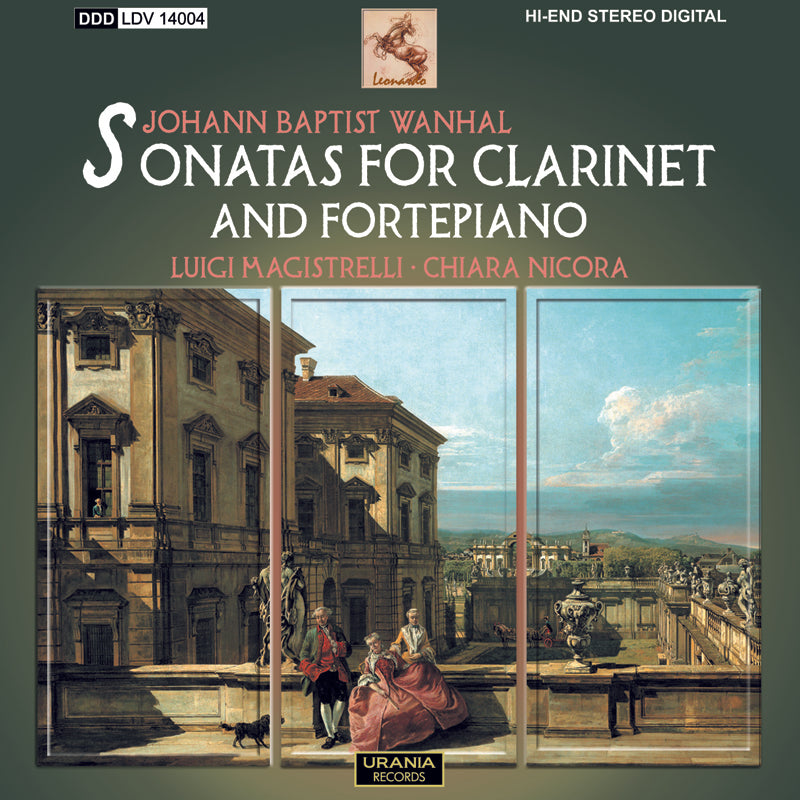
JOHANN BAPTIST WANHAL
SONATA FOR CLARINET AND FORTEPIANO
Sonata in C Major
Sonata in B-Flat Major
Sonata in E-Flat Major
Theme and Variations°
Quid Ultra inquire°
*First World Recordings
LUIGI MAGISTELLI , clarinet – CHIARA NICORA, fortepiano – MARGHERITA TOMASI , soprano
PRODUCT DESCRIPTION
J. B. Wanhal (original name in Czech Jan Krtitel Vanhal) belonged to that long line of composers and performers Bohemians of a certain caliber who distinguished themselves in the Viennese milieu in the second half of the eighteenth century. He wrote as many as 700 compositions, including at least 73 symphonies, 100 quartets, 95 sacred music compositions, and a large number of chamber works using various wind instruments, including the clarinet, the youngest representative of the wind family, which was evolving organologically to become one of the preferred instruments in the chamber and solo compositions of the great classical composers. Wanhal was in contact with Mozart and Haydn and undoubtedly absorbed their stylistic influence. Wanhal wrote several trio compositions for clarinet, bassoon, and bass (or two clarinets and bass), recorded by the undersigned. (for the Czech label Arta) 6 Trios with violin, clarinet and bass, two Quartets for clarinet and strings and a Concerto for clarinet in C and orchestra. The three Sonatas for clarinet and fortepiano (or for harpsichord and clarinet or violin, viola and even cello, as appears in the title page of the first printed editions of these compositions) are to be counted among the first classical sonatas composed for clarinet and fortepiano (harpsichord or piano). Wanhal's sonatas were conceived with the typical classical formal structure in three movements, with elements of transition between the late Baroque and Classical styles. The Sonata in C major requires the use of the clarinet in C and was published by the Viennese publishing house Sauer in 1800. Modern editions have operated the transport in B flat for a greater accessibility of the composition itself, but in this way the incisive, brilliant and joyful character that distinguishes it is partially lacking. In this CD the clarinet in C is used to preserve and respect the composer's original idea. The clarinet was therefore a rather congenial instrument for Wanhal. The Theme with Variations is not, in truth, a composition that can be ascribed with certainty to Wanhal. The non-autograph manuscript bearing the name of this composer is found in the library of the "O. Vecchi" Music Institute in Modena. The writing is typically classical with a simple and disenchanted theme varied with a coda of a decisive and brilliant character. Some rhythmic and thematic figurations can, however, be traced back to the style of Wanhal. The Aria “Quid ultra inquire” for soprano with obbligato clarinet and orchestra (here reduced with piano accompaniment by Nico Bertelli who was the first to publish it) recorded on this CD for the first time, reflects a frequent practice that originated in the classical age but which also developed consistently in the romantic one of combining the clarinet, which has always been defined as one of the wind instruments with the timbre-expressive characteristics closest to the human voice.

-

Shipping physical products
Free shipping in Europe (EU), for 4 items or more - Request a quote for shipping costs for non-EU countries
-
Digital product delivery
Digital products will be delivered directly on the website and you will also receive an email with a link to download the files.
-
Write a review
Above, you can write a review of the product you purchased; we would be happy to hear your opinion.
