

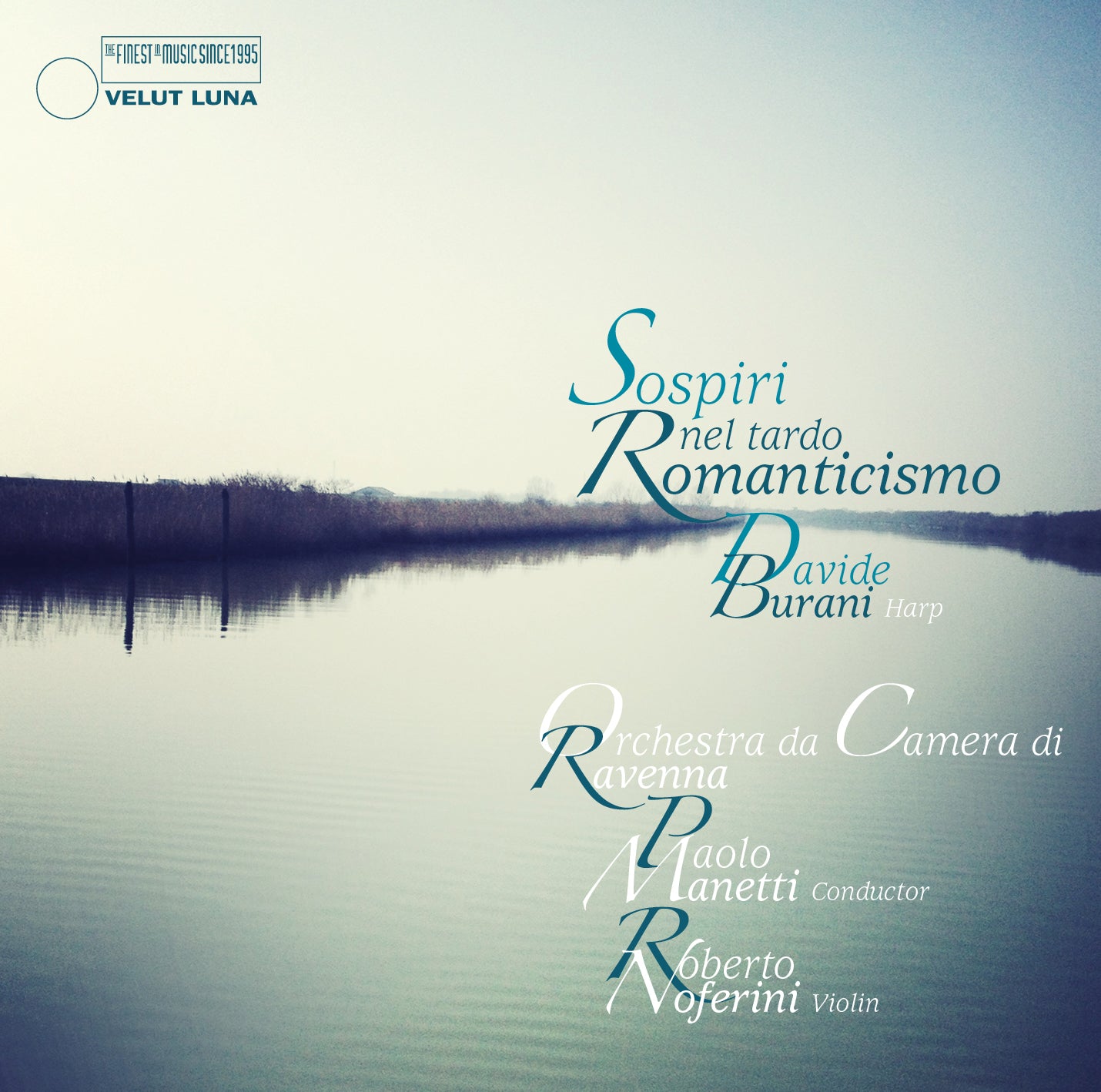
SIGHINGS IN LATE ROMANTICISM - Burani, Ravenna Chamber Orchestra; Manetti; Noferini
SIGHINGS IN LATE ROMANTICISM - Burani, Ravenna Chamber Orchestra; Manetti; Noferini
Velut Luna
Music genre: Classica
In stock
Couldn't load pickup availability
SKU:CVLD239CD
SIGHS IN LATE ROMANTICISM (CVLD239)
Author: AAVV
Performer: Davide Burani: Harp; Orchestra da Camera di Ravenna; Paolo Manetti : Conductor; Roberto Noferini: Violin
Available in: File HD, CD
Production: Velut Luna
Recording: Marco Lincetto
Editing: Mattia Zanatta
Stereo Mix & mastering: Marco Lincetto
Critical text: Iole Di Gregorio
Layout: L’Image
Marketing & Sales Manager: Patrizia Pagiaro
Tracks
01 - Claude Debussy: Danses - Danse sacrée
02 - Claude Debussy: Danses - Danse profane
03 - Edward Elgar: Elegy op 58
04 - Edward Elgar: Sospiri op 70
05 - Giovanni Caramiello: Duetto sulla Casta Diva del Bellini (transcribed for solo harp by D Burani)
06 - Jules Massenet: Méditation de Thaïs
07 - Luigi Maurizio Tedeschi: Fantasia op 48
08 - Luigi Maurizio Tedeschi: Elegia op 22
09 - Marcel Grandjany: Aria in classic style
10 - Jean Sibelius: Andante festivo op postuma
Notes
Harp and strings together in Romanticism
Iole Di Gregorio
Romantic sensibility led to the conception of melody as inextricably linked to the specific voice of an instrument, which determines how it vibrates and resonates in the soul. Although timbre is the primal, alogical, and instinctive element of music, composers until the eighteenth century had prioritized other elements of composition. The new attention to "sound in itself" fostered the transformation of string playing techniques and the search for original timbral blends in the orchestra, the refinement of traditional and newly invented instruments, and the valorization of ancient instruments rich in memories, such as the harp. Behind the modern harp, invented by Sebastian Erard in 1811 and equipped with 47 strings and 7 pedals, it is easy to discern the instrument whose origins are lost in myth and which, with a positivist spirit, we can trace back to the first applications of homo faber.
Throughout the romantic nineteenth century, predominantly in France – already on the eve of the Revolution, the harp was Queen Marie Antoinette's favorite instrument – we witness the progressive integration of the harp into the orchestral ensemble, consecrated by Hector Berlioz's treatise. Concurrently, the use of the harp in opera became established, as evidenced by the refined timbral blend of the Meditation from Jules Massenet's (1842 – 1912) Thaïs. Traces of the operatic world are found in the suggestive and charming compositions of Giovanni Caramiello (1838 – 1938), for many years an acclaimed harpist at the Teatro S. Carlo in Naples, author of a Duetto sulla Casta Diva del Bellini, for harp and piano, here offered in Davide Burani's transcription for solo harp.
The exploitation of the harp culminated in the symphonic production of Claude Debussy (1862 – 1918), who often included two harps in his scores and made extensive use of glissandi to create an impressionistic sound. The Danses sacrée et profane were commissioned in 1904 by the Pleyel House, which intended to promote a new "chromatic" harp model in competition with the aforementioned diatonic harp, a monopoly of the Erard firm. The new instrument did not manage to establish itself, but Debussy's Danses can, fortunately, be performed on the pedal harp thanks to the transcription by Henriette Renié, a renowned French teacher and concert artist. Since their first performance on November 6, 1904, at the Concerts Colonne in Paris, the Danses have created a reference model for European composers, exerting an influence comparable to that of Mahler's Adagietto from his Fifth Symphony in 1902, echoed in the stand-alone piece Sospiri op. 70, composed in 1914 for strings and harp by the English composer Sir Edward Elgar (1857 – 1934), to whom we owe some cornerstones of late Romantic string orchestra literature. Marcel Grandjany (1892 – 1974), an American harpist and composer of French origin, trained at the Paris Conservatoire, dedicated his Aria in classic style in 1937 to the harp and string ensemble, confirming the solidity of this union and the persistence of French harp taste worldwide.

-

Shipping physical products
Free shipping in Europe (EU), for 4 items or more - Request a quote for shipping costs for non-EU countries
-
Digital product delivery
Digital products will be delivered directly on the website and you will also receive an email with a link to download the files.
-
Write a review
Above, you can write a review of the product you purchased; we would be happy to hear your opinion.
