

O CRUX BENEDICTA - DE LABYRINTHO
O CRUX BENEDICTA - DE LABYRINTHO
Velut Luna
Music genre: Classica and Latino
In stock
Couldn't load pickup availability
SKU:CVLD168CD
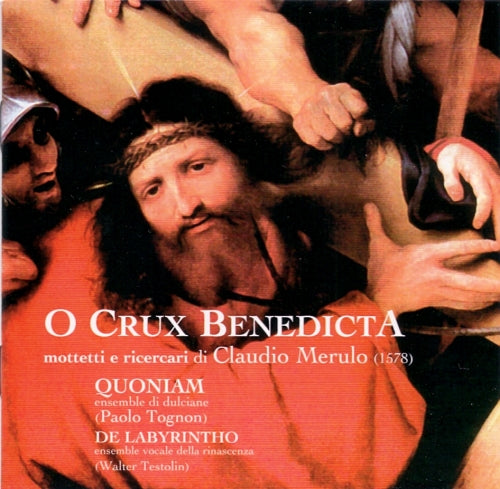
O CRUX BENEDICTA ( CVLD168 )
Author : CLUDIO MERULO
Performer : QUONIAM DE LABYRINTHO
Available in: CD, CD File
Traces
01 - Liber secundus sacrarum cantionum quinque vocum: Hace est Domus Dei
02 - Liber secundus sacrarum cantionum quinque vocum: Tribulationem et Dolorem
03 - Liber secundus sacrarum cantionum quinque vocum: O Crux benedicta
04 - Liber secundus sacrarum cantionum quinque vocum: Domine, si adhuc populo
05 - Toccata of the Seventh Tone 'O admirabile commercium'
06 - Liber primus sacrarum cantionum: Hodie Spiritus Sanctus
07 - Ricercari to sing: Ricercare tenth to four
08 - Liber primus sacrarum cantionum: Hodie Spiritus Sanctus
09 - Liber secundus sacrarum cantionum quinque vocum: Tanquam aurum in furnace
10 - Liber primus sacrarum cantionum: Maximum hoc omnium
11 - Liber secundus sacrarum cantionum quinque vocum: Vos qui reliquistis omnia
12 - Ricercari to sing: Ricercare first to four
13 - Liber primus sacrarum cantionum: Ascendens Christus in altum - Instrumental Version
14 - Liber primus sacrarum cantionum: Ascendens Christus in altum
15 - Liber primus sacrarum cantionum: Sancti et justi
16 - Liber primus sacrarum cantionum: Hail Mary
17 - Ricercari to sing: Ricercare vigesimo a quattro
18 - Liber secundus sacrarum cantionum quinque vocum: Pax vobis, ego sum
19 - Liber secundus sacrarum cantionum quinque vocum: Haec est Virgo prudens
20 - Liber secundus sacrarum cantionum quinque vocum: Gaude, felix parens Hispania
Notes
CLASSICAL: motets and ricercares by Claudio Merulo. Qoniam: Dulcian ensemble (P. Tognon); De Labiryntho: Renaissance vocal ensemble (Walter Testolin).
24/96 kHz digital recording made at Auditorium Comunale Chiuppano, Vicenza on December 2000.
“You should know that all instruments are less worthy than the human voice in comparison, so we will strengthen ourselves by learning and imitating it.”
This is what Silvestro Ganassi said in 1538 on the frontispiece of his treatise: “La Fontegara”, which instructed wind musicians in the refined and complex art of their learning.
We can rightly take this exhortation as an example, as a model of ideal expression to aim for in the performance of the music itself.
The pieces performed are part of the collection "Liber Primis Sacrarum Cantinum Quinque Vocum," published in 1578 by Claudio Merulo. This is a collection of motets, polyphonic vocal compositions in Latin, intended to be performed during Mass or other liturgical functions.
The organ and the voices were the preferred means of communication and were always supported by a varied array of instruments. The most archaic bassoon model, called the chorista bassoon (or dulciana), was one of the most effective instruments for interacting with the voices.

-

Shipping physical products
Free shipping in Europe (EU), for 4 items or more - Request a quote for shipping costs for non-EU countries
-
Digital product delivery
Digital products will be delivered directly on the website and you will also receive an email with a link to download the files.
-
Write a review
Above, you can write a review of the product you purchased; we would be happy to hear your opinion.
