
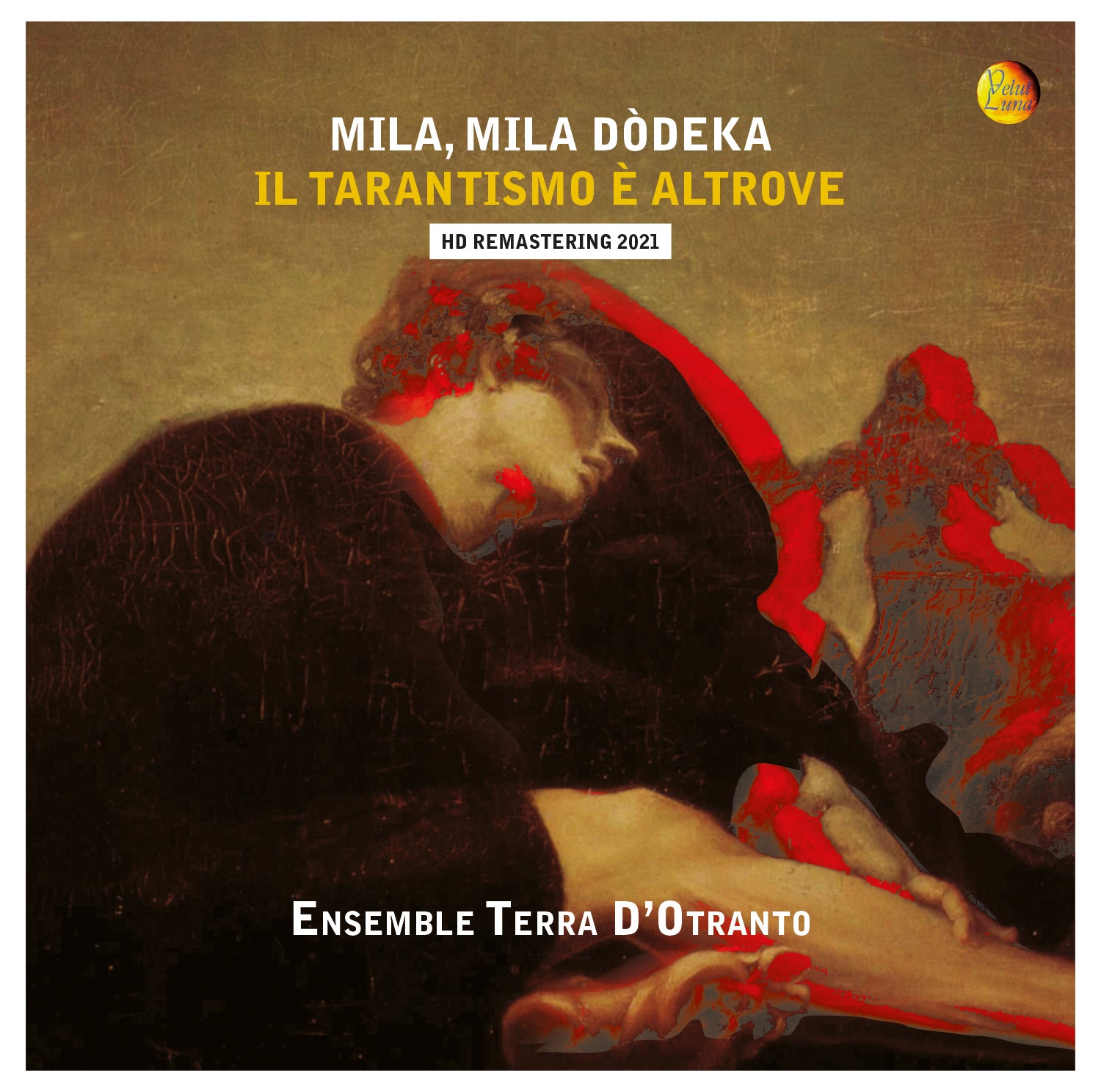
MILA, MILA DODEKA - Ensemble Terra D’Otranto
MILA, MILA DODEKA - Ensemble Terra D’Otranto
Velut Luna
Genere musicale:
In stock
Couldn't load pickup availability
SKU:CVLD341
MILA, MILA DODEKA(CVLD341)
Tarantism is Elsewhere
1. Lamento (Lament) Traditional / Arr. D. Longo 1:41
2. Klafsete, Mane (Weep, Mothers) Anonymous, Grecìa Salentina * 0:38
3. S’è ver la tua partita G. Melcarne “Il Montesardo”, from op. XI, Naples 1612 2:44
4. Zoì (Life) Traditional / Arr. L. Tarantino-R.Conte 2:11
5. Aria sopra il Fedele Traditional / Improvisations 2:13
6. Santu Paulu Traditional from Salento 0:55
7. Variations for tambourine Traditional from Salento 1:09
8. Pizzica “de core” (“from the heart”, courtship dance) Traditional from Salento 3:47
9. La Vergine Maria Traditional from Salento 4:07
10. Battle of Tarantellas Improvisations on works by F.Pico and anonymous 17th and 18th centuries 6:40
11. Nia nia nia- Traditional from Grecìa Salentina 2:21
12. Rodrigo Martines Anonymous Spain 16th century 2:09 “On the Pains of Love”
13. Improvisation on a bass by N. Matteis (17th century) 1:42
14. Tarantella G. Greco, Naples 17th century 2:01
15. Pizzica Traditional from Salento 1:52
16. Passacaglia Traditional / Improvisations 0:56
17. Antidotum Tarantula and Anonymous 16th century, Traditional / Improvisations 2:36
18. Tarantella tonum phrygium Anonymous 16th century, Traditional 3:21
19. Mila, Mila Dodeka (Apples, Apples Twelve) (“moroloja”, funeral lullaby), Traditional from Salento 1:24
20. 'Ntartieni, Biumbò Traditional / Arr. L. Tarantino, D. Longo, A.C. Villani, M. Durante 5:44
Total time 50:31
* First four stanzas taken from an elegy in terza rima, of about 200 verses, composed in 1556 on the death of a young girl named Katerini (Catherine).
ENSEMBLE TERRA D’OTRANTO
Doriano Longo direction; violin R. Duke, London 1756 viola da braccio Anon. German school, late 18th century
Anna Cinzia Villani solo voice, tambourine (track 15)
Nadia Esposito reciting voice, voice, castanets (track 10)
Rosario Conte Spanish guitar P. Busato, Padua 1998 copy Franco-Belgian school, second half 17th century) theorbo (tracks 3, 11, 12): Lourdes Maria Uncilla, El Escorial, Spain, 2001
Luca Tarantino Spanish guitar L. Lovadina, Aralde (TV) 1987, “Giustiniani” 1681 model by A. Stradivari chitarra battente G. De Iaco, Dorfgasse, Switzerland, 1998
Pierluigi Ostuni theorbo Lourdes Maria Uncilla, El Escorial, Spain, 2001
Mauro Durante frame drums (tracks 10, 20); castanets (track 12)
Roberto Chiga frame drums (tracks 7, 11, 12)
Pippo Ark” d’Ambrosio percussion
Guests:
Franco Corlianò, reciting voice (Klafsete, Mane)
Gianni de Gennaro, vielle (La Vergine Maria)
Nicola Nesta, oud (La Vergine Maria and ‘Ntartieni)
Michele Visaggi, harpsichord (Sulle Pene d’Amore)
24 bit 96 kHz original recording at Masseria Torcito – Cannole (Lecce) October 2, 3 2003
Production: Velut Luna
Sound Engineer Marco Lincetto
Recording director Gianni de Gennaro
Editing and mastering Matteo Costa
Layout L'image
PR Francesco Pesavento
A special thanks to:
Abele / Antonio Cassano director of the provincial museum of Lecce
Sandro Mele, author of the work on the cover
Franco Corlianò and Maria Roca Montinaro custodians of the Griko language
Fernando de Lumè president of the social cooperative “La Sorgente” of Masseria Torcito
“Mila, Mila Dòdeka...” Twelve Apples...” The apple, like the quince and the pomegranate, is a symbol of life and death. It is linked to the cult of Persephone, daughter of Demeter, goddess of fertility, abducted in the prime of her youth by Hades, the god of the underworld. For having eaten a pomegranate seed, Persephone cannot return to the world of the living, except for part of the year. Dividing herself between light and darkness, she gives rise to the continuous cycle of the seasons. A Hellenic religiosity whose myths and rites still live in the Terra d’Otranto of the seventeenth century, as shown by the lullabies collected here. Lullabies sung in Griko, the language of a migrant people, with sounds pregnant with the pain of farewell and the anxieties of the journey. A language that survived in Salento, a land of passage, along with other myths and rites that are collected here according to a succession of moments of life and death. Life and Death go together, in a continuum between what one takes and offers to the other. Thus, one moves from the funeral lament to the lullaby, from frenzied dance to the lament for the tarantula's bite. In the same way, a lullaby for the departure of a child transforms into a nursery rhyme for newborns, rocked on the knees by the grandfathers' bium-bò and accompanied by the reassuring voice of mothers. In the shelter of a fortified farm, with a small chapel on the edge of a track that reverberates like a cathedral, what emerged from scattered plots and momentary intuitions was collected. According to Baroque practice, and popular tradition, each performance has its own story; the notes, when present, are above all signs, directions. For the rest, there is the moment, in this case, that of the recording, where, unlike a concert, one mainly addresses oneself. In this setting of contemplation and continuous discovery, pieces and texts by known and unknown authors from Terra d'Otranto and the cultures still present in Terra d'Otranto in the seventeenth century were brought back to life after four centuries: their legacy is like the twelve apples that the mother gives to her dead son as a viaticum. What we hope is to be able to preserve it for those who will come... Ti tuso kosmo presta trapassei”... Because this world soon passes!
Abele and Doriano Longo

-

Spedizioni prodotti fisici
Spedizioni gratuite in Europa (UE), a partire da 4 articoli - Richiedere quatozione per i costi di spedizione per i paesi non UE
-
Consegna prodotti digitali
La consegna dei prodotti digitali avverrà direttamente sul sito e riceverai anche una email con il link per il download dei file.
-
Scrivi una recensione
Qui sopra puoi scrivere una recensione sul prodotto che hai acquistato, saremo felici di conoscere la tua opinione.
