


FORNACIARI (Violin) | Fornaciari
FORNACIARI (Violin) | Fornaciari
Fonè
Genere musicale: Classica
In stock
Couldn't load pickup availability
SKU:DSD8301
FORNACIARI
Violin
Available in: DSD, Hi-Res Audio
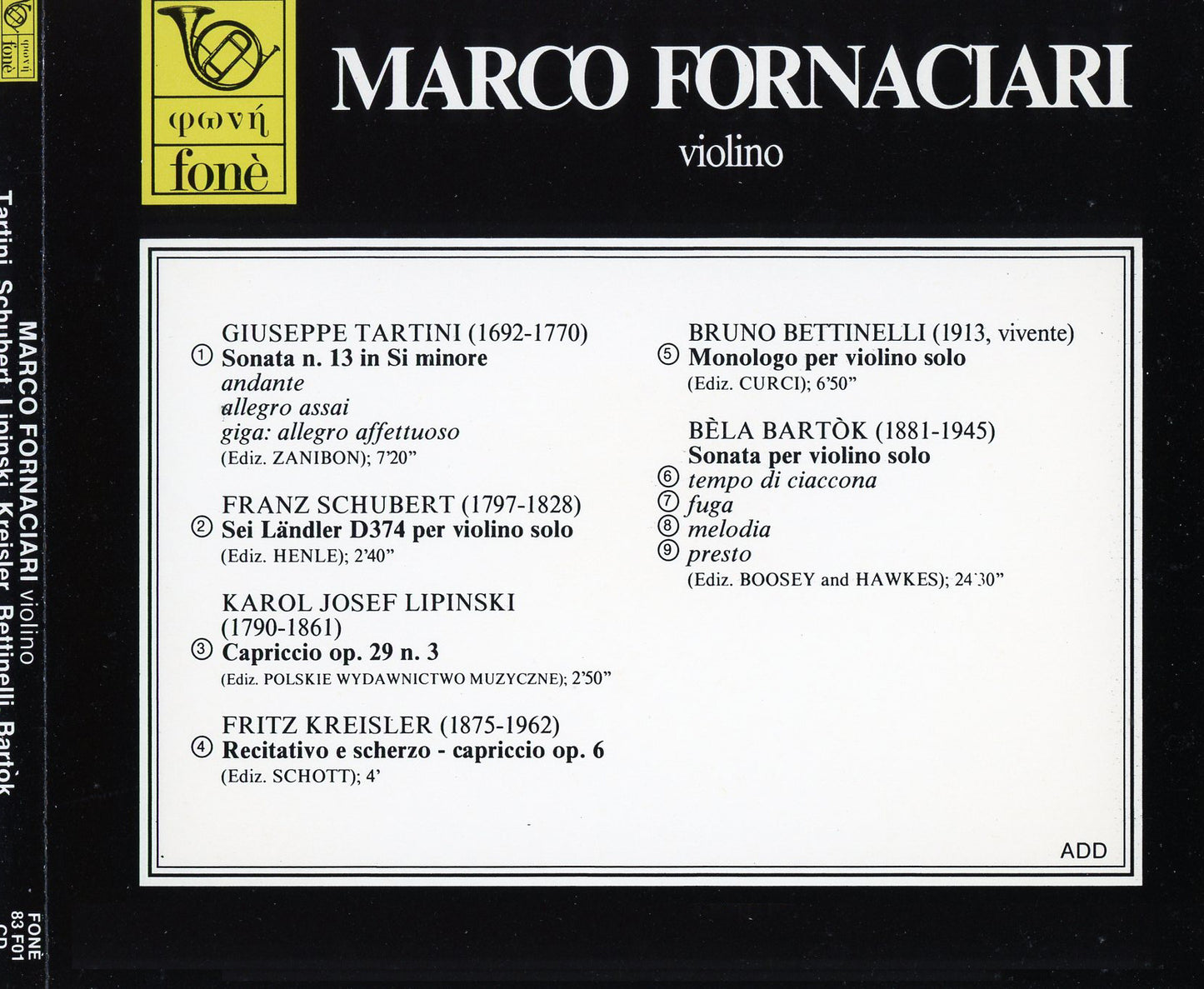
Track list:
GIUSEPPE TARTINI (1692-1770)
- Sonata No. 13 in B minor
Andante
Allegro assai
Giga: allegro affettuoso
(Ed. ZANIBON); 7‘20“
FRANZ SCHUBERT (1797-1828)
- Six Ländlers D374 for solo violin
(Ed. HENLE); 2’40”
KAROL JOSEF LIPINSKY (1790-1861)
- Capriccio Op. 29 No. 3
(Ed. POLSKIE WYDAWNICTWO MUZYCZNE); 2’50”
FRITZ KREISLER (1875-1962)
- Recitative and Scherzo-Caprice Op. 6
(Ed. SCHOTT); 4’
BRUNO BETTINELLI (1913, living)
- Monologue for solo violin
(Ed. CURCI); 6’50”
BÈLA BARTÒK (1881-1945)
Sonata for solo violin
- Tempo di ciaccona
- Fuga
- Melodia
- Presto
(Ed. BOOSEY and HAWKES); 24’30”
Notes
STEREO
INSTRUMENT:
Vettori Violin 1981
RECORDING PLACE:
Livorno, San Ranieri Chapel, October 10/14, ‘83
RECORDING:
Studio R.G.C. Livorno
PRODUCTION DIRECTOR:
Giulio Cesare Ricci
SOUND ENGINEER:
Giulio Cesare Ricci
MARCO FORNACIARI violin
A few words to justify the program presented in this edition will not be superfluous. At first glance, especially to the European public, it might appear eclectic, if not incoherent, or in any case chosen with outdated concert criteria. Now, without forgetting that editions of this kind are frequent, especially in the USA and USSR, which is certainly not insignificant, it must be said that when it comes to highlighting the qualities and characteristics of a modern instrument like the violin made by Carlo Vettori in 1981, it is natural to lean towards representative music, both in chronological terms and in terms of compositional school. This is how Marco Fornaciari chose to attempt a repertoire that ranges from the early 18th century to the present day.
GIUSEPPE TARTINI (1692-1770), from Istria, violinist, sound theorist, and harmony scholar, reveals in his "Sonata No. 13 in B minor" (taken from a group of 24, of which the autograph is preserved in Padua) the stylistically simple breadth, projected towards a barely hinted virtuosity, of the pure and elegant 18th-century expressive lines.
The Six Ländlers for solo violin D 374 by FRANZ SCHUBERT (1797-1828), composed in February 1816, are a small, almost unknown gem by the Viennese master, and present the tones and cadences of the Waltz (which derives from the ländler, a popular rural dance) purified, however, of the symphonic refinements to which the Strausses, among others, have accustomed us.
Scarcely known, KAROL JOZEF LIPINSKI (1790-1861), a Polish violinist, eclectic composer, and orchestra conductor. A rival of Paganini, with whom he did not fare badly in a concert competition, he composed no less than 4 collections of Capriccios, in the Italian style. From Op. 29, "Capriccio" No. 3 is performed, a dazzling cascade of notes in the purest virtuosic style of the early last century.
The "Recitative and Scherzo-Capriccio" Op. 6 by FRITZ KREISLER (1875-1962), on the other hand, is a brilliant example of how the late-Viennese melodic tradition continues in our
century; the great celebrity of this work makes it superfluous to dwell on it.
Of significant interest is the "Monologue for solo violin" by BRUNO BETTINELLI (1913, living), a master who taught more than one generation of musicians from the composition chair of the "G. Verdi" Conservatory in Milan. Not tied to schemes or schools, not influenced by fads, Bettinelli demonstrates how it is possible to compose, today, music enjoyable even by the wider public, provided that the ties with Italian cantabile are not broken.
With the "Sonata for solo violin" dedicated to Y. Menuhin, composed in the classical four-movement structure of the sonata da chiesa, one of the most difficult pieces in all violin literature, both in terms of musical writing and technique, BÉLA BARTOK (1881-1945) contributed decisively to pushing the limits of human possibilities in concert performance.
MARCO FORNACIARI (1953), who graduated from the "L. Cherubini" in Florence, obtained his Konzertdiplom in Geneva, under the guidance of Maestro Corrado Romano, receiving the "premier prix avec distinction". He has performed concerts all over the world, both as a soloist and as first violin of the "Solisti Veneti". The instrument used for the performance was built in 1981 by CARLO VETTORI, a Florentine luthier who, in his now thirty years of activity (he began working at a very young age in the workshop of his father Dario, also an esteemed luthier), has achieved numerous successes.


-

Spedizioni prodotti fisici
Spedizioni gratuite in Europa (UE), a partire da 4 articoli - Richiedere quatozione per i costi di spedizione per i paesi non UE
-
Consegna prodotti digitali
La consegna dei prodotti digitali avverrà direttamente sul sito e riceverai anche una email con il link per il download dei file.
-
Scrivi una recensione
Qui sopra puoi scrivere una recensione sul prodotto che hai acquistato, saremo felici di conoscere la tua opinione.
