

LA PALMA | Coclite
LA PALMA | Coclite
AudioRecords
Genere musicale: JAZZ
In stock
Couldn't load pickup availability
SKU:ARJL001HD
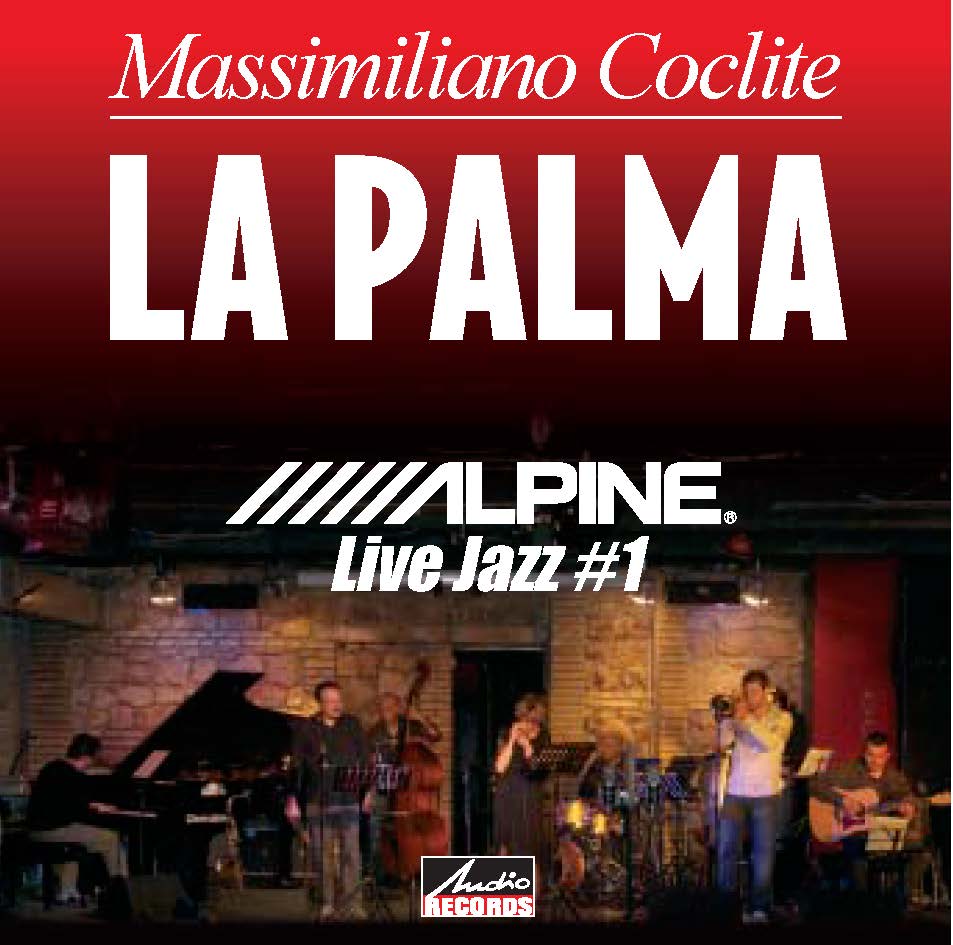
LA PALMA
Massimiliano Coclite, Live Jazz #1
Available in: CD, HD File
Track list
01 - Stiletto - 8’: 17” - Billy Joel
02 - Only a Dream in Rio - 6’: 50” - James Taylor
03 - De Do Do Do, De Da Da Da - 6’: 11” - Gordon Sumner,
Stewart Copeland & Andy Summers
04 - Cores de Manha - 9’: 11” - Alessia Martegiani (ed. TechniPress Ed. Mus.)
05 - Thriller - 9’: 27” - Michael Jackson
06 - Africa - 8’: 23” - Jeff Porcaro
07 - Nightwalker - 7’: 37” - Gino Vannelli
08 - Careless Whisper - 7’: 44” - George Michael, Andrew Ridgeley
09 - Just the Way You Are - 5’: 54” - Billy Joel
10 - Superstition - 8’: 02” - Stevie Wonder
Notes
Two splendid spring evenings in Rome, under a sky full of stars, with a good red wine from the Castelli Romani. A group of friends prepare for a musical event with an attentive audience, in one of the most beautiful jazz clubs in the Eternal City. These are musicians of great caliber, each dedicated to their own music, to their own artistic life. They manage to play together too few times but, punctually, they manage to make us enjoy the thrill of a strong and memorable performance.
Discreetly, AudioRecords is there with them. The evening, like the following one, will be recorded and will, once again, be a challenge. But this does not scare these musicians; it stimulates them. To do better, to give more. They have already recorded for this label and know perfectly well that no cuts, patches, or other editing operations will be made. The music will flow from their hearts, and their hearts will be captured and "fixed" on this record. And a misplaced note will certainly not scare us; on the contrary, it will be precisely this that signals that the heart, at times, beats strongly even "out of rhythm" and is "true" precisely for this reason.
Of the evening at La Palma, AudioRecords and Stefano Isola sought to capture the "sound" of the ensemble. Of the venue, of the stage. Without introducing artificialities, without interventions intended to necessarily make it "prettier," seeking only to capture, on a record, an event, a sound. Not the best possible sound, as many continue to propose even on live records, but "that" sound, the one that could be heard at La Palma, in Rome, on those two April evenings. And that stage, precisely that one, with the musicians sweating, playing, creating.
Alongside AudioRecords, the friendly presence of Alpine Italia. They strongly wanted this event. They awaited it and followed it. They knew how to "see" it through my words and shared my enthusiasm. They allowed a dream to come true, for the group of friends to welcome other friends. For the evening to be enriched by other great musicians, by a guitar, to complete the "sounds," by two voices, different in genre but both excellent, in quality, certainly, but above all in "heart." Sharing technical and artistic choices. Sharing the crisp air of Rome and the great passion for good music, the "true" kind, even on records.
"La Palma" is a magical record. There are not just notes. There is not just the atmosphere. There is music, made with the heart, all for you, thanks to Massimiliano, Stefano, and Alpine.
Enjoy listening.
Rocco Patriarca
THE STAGE
It is not difficult to imagine what the listener of a recording of a sound event, however complex, expects from a reference system. Beyond the timbre of the room and instruments, the dynamics of the recording, the system's ability to follow the individual evolutions of the instrumentalists in their passages through the progress of musical structures and, at the same time, the cohesion of the different sound messages.
The shrewdest, however, seek something else. They want the stage, the sensation of the sound event unfolding before their eyes and resonating, just as in the concert hall, around them. This is what we enthusiasts have always sought in many "reference" records, where an indication, a note from someone present at the time of recording, could allow us to reconstruct, at least mentally, the arrangement of the instrumentalists on the stage. Thanks to AudioRecords, however, this search is no longer necessary. The stage of this concert is before your eyes, not only in a diagram from which to draw the "footprints" of the instruments on the stage, but even photographed, to demonstrate the desire to make everyone participate in the event. Maestro Massimiliano Coclite's piano is positioned to the left of the stage. In reality, we would have liked it in a different position, but we could not move it without the cost of a long and difficult tuning session. Its tail extends towards the center of the stage, and Massimiliano's voice is inevitably in the keyboard area, on the left side of the stage. In the center-right, towards the back, the drums of the great Marcello Di Leonardo serve as a reference. Due to the distance, the drums are very "large" in the recording and sometimes overlap with Bruno Marcozzi's percussion, placed just to their right. Between the drums and the piano, still in the rear area of the stage, Luca Bulgarelli's double bass, perhaps a bit sacrificed in the overall sound. The two wind instruments are respectively in the center-right and center-left of the sound scene. Naturally, the focus is on the microphones, to which the different instruments played to the left of the center of the stage by Fabrizio Mandolini (saxophones) and to the right, again relative to the center of the stage, by Fabrizio Bosso (trumpet and flugelhorn) refer.
The two guest singers found their natural "front" position and placed themselves in the very center of the scene. The two songs they performed, therefore, can serve as a reference for fine-tuning the center of the reproduced sound scene. Mauro De Federicis's guitars found their place at the far right of the stage, in contrast to the piano, positioned to the left. As in every "true" recording, the room played a decisive role, also due to the existing amplification which, although of excellent quality, influenced the overall balance, offering that sense of "live" that shines through in every note of this record.
RECORDING TECHNIQUES
Recording a live concert compared to a studio recording presents objective difficulties, particularly related to the unknowns given by the unpredictability of events. The progress of the performance follows its own path constrained by the needs of the show; it cannot be controlled but, on the contrary, one must promptly adapt to its rhythms. As a counterpart, it allows for unique results regarding sound, dynamic impact, and the spontaneity of the performance. Among all the experiences a sound engineer can undertake, this is certainly the most exhilarating precisely because of the uniqueness and freshness of the material he deals with: this is the fundamental reason why we once again and enthusiastically insist on adopting this formula. In view of all this and to reproduce a natural environmental acoustic, we have developed a recording system (already successfully used in our previous productions) which has also confirmed all its qualities in this case. It contemplates a hybrid configuration based on a stereo recording system combined with a series of direct microphone placements on individual instruments with the use of delay lines.
The stereo recording system used can be considered semi-binaural since it employs a Jecklin disc as an artificial head, and is characterized by a very faithful reconstruction of the acoustic image of the environment and an unusual linearity and bass extension. The result is a sound with unique compactness and coherence that retains all the original impact of a live performance, including ambient noises: some of the apparent imbalances actually characterize the performance, giving that extra emotion that such an event conveys. From a technical point of view, the philosophy is to use equipment of undoubted quality in a minimal configuration. We once again used a pair of RME Octamics, eight-channel microphone preamplifiers with integrated 96 kHz 24-bit digital interface, which allowed us to have high quality and a direct connection to the PC via ADAT optical digital connections.
The digital signal reception card installed on the computer is still an RME Hammerfall 96/52 PCI, while the recording and mixing software is the well-established Steinberg Nuendo, indispensable for its versatility and audio quality.
Stefano Isola
THE MICROPHONES
I have always been convinced that for recording a sound event, certain skills of the recording engineer are very important: a deep knowledge of the correct placement of transducers and the ability to use the technical "material" available by exploiting its "merits" and apparent "defects." Boasting the use of famous brands or only listing the models used is a criterion that gives a very relative indication of how effectively the results on the record were achieved. It is clear, therefore, that I consider mic placement a moment of fundamental importance for recording, and I will try in these few lines to give at least the most significant indications on the criteria followed. Let's start with the pair that forms the basic stereo configuration: these are two large-diaphragm condenser microphones from SE Electronics, model Z3300. They were chosen (usually small-diaphragm models are used) for their sensitivity, bass extension, and slight emphasis on the highs, characteristics that allow for a detailed reconstruction of the ambient image. For the trumpet, we preferred a less common ribbon microphone from Oktava, the ML-52 model; this type of transducer has the advantage of withstanding high sound pressure, having a certain timbral "darkness," and natural compression, characteristics that are well suited for recording bright and dynamic instruments such as wind instruments. On the drums, a selected pair of Rode NT5s in an X-Y stereo configuration, in this case very effective as they are more detailed and less sensitive than equivalent condenser transducers, while for the piano, two classic AKG C 414 B-XLS in spaced stereo. Regarding the vocals, we opted for the Neumann KMS 104, which combines quality with practicality, essential qualities for live recording. On the percussion, a pair of SE Electronics SE 3, also in an X-Y stereo configuration.
Stefano Isola
Credits
The Band
Massimiliano Coclite
Piano and vocals
Fabrizio Bosso
Trumpet and flugelhorn
Luca Bulgarelli
Double bass
Marcello Di Leonardo
Drums
Fabrizio Mandolini
Saxophones
Bruno Marcozzi
Percussion
Special Guests
Antonella Vitale
Vocals on track 4
Vittorio Matteucci
Vocals on tracks 8, 11
Mauro De Federicis
Guitars on tracks 2, 4, 10

-

Spedizioni prodotti fisici
Spedizioni gratuite in Europa (UE), a partire da 4 articoli - Richiedere quatozione per i costi di spedizione per i paesi non UE
-
Consegna prodotti digitali
La consegna dei prodotti digitali avverrà direttamente sul sito e riceverai anche una email con il link per il download dei file.
-
Scrivi una recensione
Qui sopra puoi scrivere una recensione sul prodotto che hai acquistato, saremo felici di conoscere la tua opinione.
