
L'UCCELLAJA - Mario FOLENA Roberto LOREGGIAN Francesco GALLIGIONI
L'UCCELLAJA - Mario FOLENA Roberto LOREGGIAN Francesco GALLIGIONI
Velut Luna
Music genre:
In stock
Couldn't load pickup availability
SKU:CVLD361CD
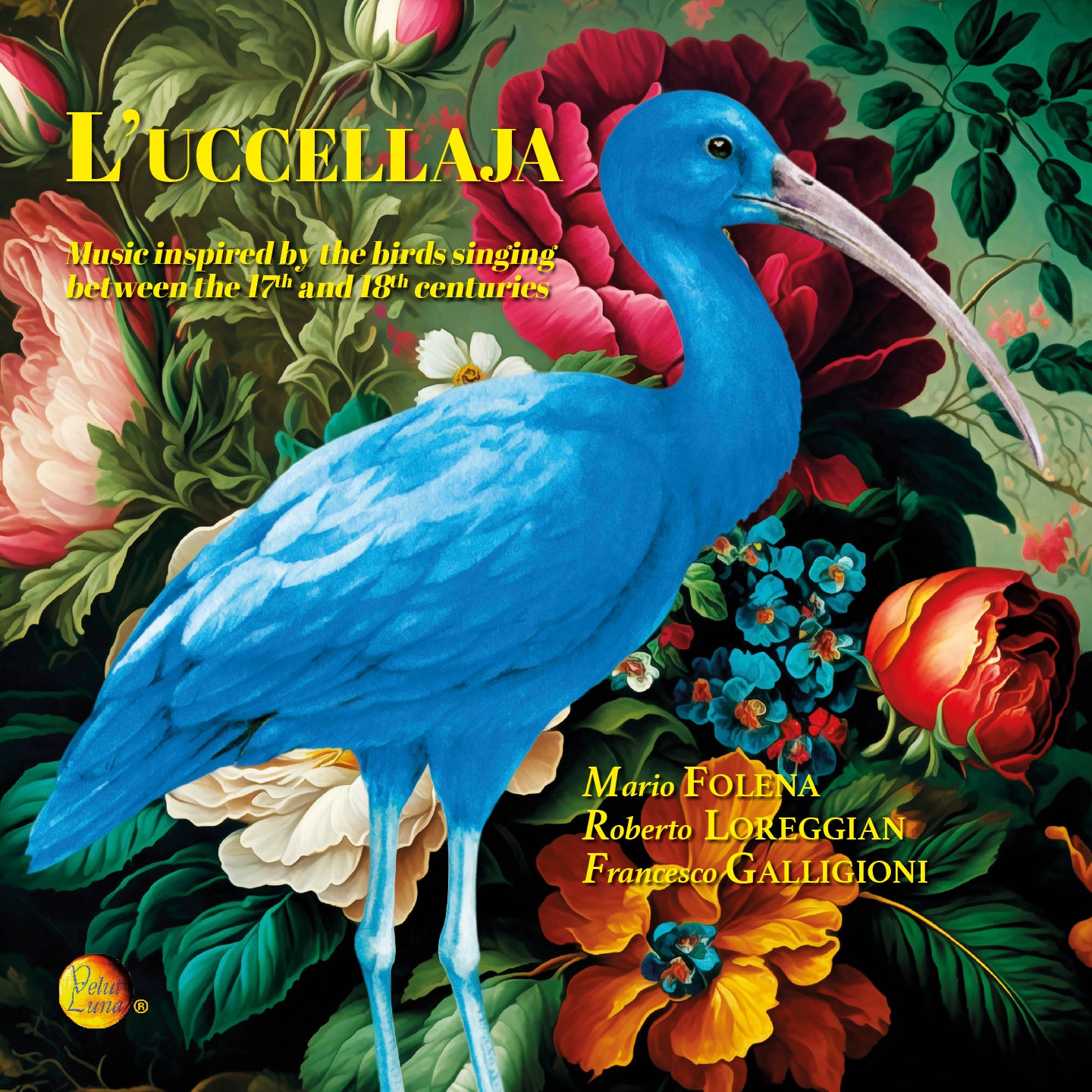
L’UCCELLAJA
Music inspired by the birds singing between the 17th and 18th centuries (CVLD361)
Mario FOLENA, traverso, flauto d’amore
Roberto LOREGGIAN, harpsichord
Francesco GALLIGIONI, cello, viola da gamba
Available in: HD Files, CD
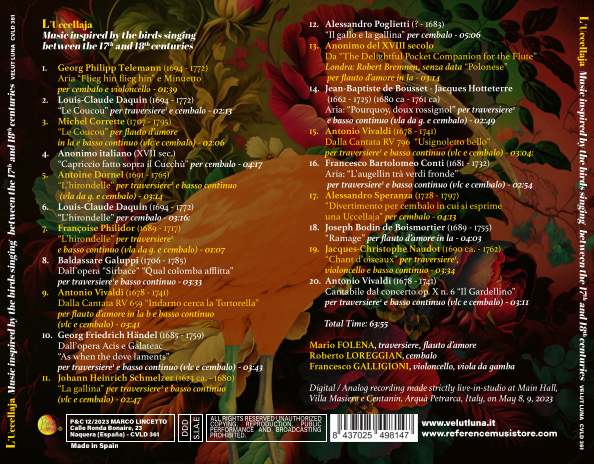
- 1. Georg Philipp Telemann (1694 - 1772)
- 2. Louis-Claude Daquin (1694 - 1772)
- 3. Michel Corrette (1707 - 1795)
- 4. Anonymous Italian (17th century)
- 5. Antoine Dornel (1691 - 1765)
- 6. Louis-Claude Daquin (1694 - 1772)
- 7. Françoise Philidor (1689 - 1717)
- 8. Baldassare Galuppi (1706 - 1785)
- 9. Antonio Vivaldi (1678 - 1741)
- 10. Georg Friedrich Händel (1685 - 1759)
- 11. Johann Heinrich Schmelzer (1623 ca. - 1680)
- 12. Alessandro Poglietti (? - 1683)
- 13. Anonymous 18th century
- 14. Jean-Baptiste de Bousset - Jacques Hotteterre (1662 - 1725) (1680 ca - 1761 ca)
- 15. Antonio Vivaldi (1678 - 1741)
- 16. Francesco Bartolomeo Conti (1681 - 1732)
- 17. Alessandro Speranza (1728 - 1797)
- 18. Joseph Bodin de Boismortier (1689 - 1755)
- 19. Jacques-Christophe Naudot (1690 ca. - 1762)
- 20. Antonio Vivaldi (1678 - 1741)
Total Time - 63:55
- Traverso 1 - Martin Wenner, copy of Carlo Palanca
- Traverso 2 - Federico Xiccato, copy of Chevalier
- Flauto d’amore in A - Federico Xiccato, copy of Dejardin
- Flauto d’amore in A flat - Giovanni Tardino, copy of Giuseppe Panormo
- Cello - Cremona, late 17th century
- Viola da gamba - Paolo Biordi, Ortimino, 2018 (from Michel Colichon, Paris, 1691)
- Harpsichord - Florindo Gazzola, copy of Anonymous Italian 17th century
- Digital / Analog recording made strictly live-in-studio at Main Hall, Villa Masiero e Centanin, Arquà Petrarca, Italy, on May 8, 9, 2023 - Analog Mix and mastering made at VL Studio, Naquera, Spain, on May 11, 12, 2023, using Rupert Neve Design Summing Mixing Console, Maselec MLA-2 / MEA-2 / MPL-2 and Studer A810
- Production: Marco Lincetto and Massimo Corvino Consulting
- Executive producer: Marco Lincettoo
- Musical producer: Marco Lincetto
- Balance, recording, mix and mastering engineer: Marco Lincetto
- Editing: Matteo Costa
- Photo: Musicians’Archive
- Cover Graphics and layout: L’Imag
To celebrate the beauty and inspiration of bird song: this is the aim of this anthology of 17th and 18th-century compositions dedicated to the voices of winged creatures. The CD takes its title from Alessandro Speranza's Divertimento per cembalo in cui si esprime una Uccellaja and includes 20 carefully selected baroque and rococo pieces.
The first piece, a previously unreleased page by G. Ph. Telemann, opens with two notes (D - B) that repeat, enunciating the cuckoo's call. This incisive musical motif, capable of being etched into our auditory memory, introduces the following tracks, dedicated in order to: cuckoo, swallow, turtledoves and doves, roosters and hens, nightingale, various songbirds
and goldfinch.
Between the 17th and 18th centuries, it was common in French instrumental suites (but also in German ones) to find movements with a title having a specific programmatic intent. From these suites (composed by Daquin, Corrette, Philidor, Schmelzer, Boismortier and Naudot) come the pieces dedicated to bird song. And many Italian musicians, such as Poglietti and Speranza, were also inspired by bird song: three pages of great expressive power for solo harpsichord by these composers and an Anonymous one are presented.
Galuppi's aria Qual colomba afflitta has come down to us only in instrumental form. It is part of a weighty collection of opera arias, published in London in the mid-18th century by John Walsh, selected and transcribed for traverso and basso continuo by Carlo Maria Broschi (1705-1782), the famous castrato known as "il Farinelli". At the time, it was still common practice to perform vocal compositions - such as opera arias or those from cantatas, French brunettes or boat songs - in simple instrumental form, as was done in the Renaissance era: a deep-rooted traditional practice with which it was also decided to perform Vivaldi's arias Usignoletto bello and Conti's L’augellin trà verdi fronde. Handel's piece As when the dove laments, on the other hand, belongs to a collection of transcriptions for traverso and harpsichord, also published by J. Walsh in London.
Within this free performing style also falls the aria Porquoy doux rossignol by the composer Jean-Baptiste de Bousset (1662 - 1725), a very popular piece at the court of the Sun King. It is a magnificent aria that Jacques Hotteterre transcribed for traverso and basso continuo, contributing to its fame and dissemination.
The Delightful Pocket Companion for the Flute, from which the Polonese by an unknown author performed here on the flauto d’amore is taken, is a pocket vademecum in several volumes published in London - undated - by Robert Bremnen. It contains hundreds of original and transcribed pieces for the numerous amateur flutists, who were increasingly eager for repertoire for their instrument. The theme of this Polonese, a Polish dance movement in three-quarter time, is the clucking of a hen, so much so that with a play on words it could be renamed Pollonese.
The CD concludes with the famous Cantabile from Concerto Op. X no. 6 "Il Gardellino" by Antonio Vivaldi, whose pure and linear melody is embellished in this CD, during the ritornelli, in the same capricious spirit as Alessandro Speranza's piece: and so, in addition to the typical arpeggiated call of the goldfinch, one can hear the imitation of a myriad of chirping birds, a tribute to the greatness of Nature, with a triumph of notes and sounds that aims to transport us into a world of emotions and beauty.
Mario Folena

-

Shipping physical products
Free shipping in Europe (EU), for 4 items or more - Request a quote for shipping costs for non-EU countries
-
Digital product delivery
Digital products will be delivered directly on the website and you will also receive an email with a link to download the files.
-
Write a review
Above, you can write a review of the product you purchased; we would be happy to hear your opinion.
