
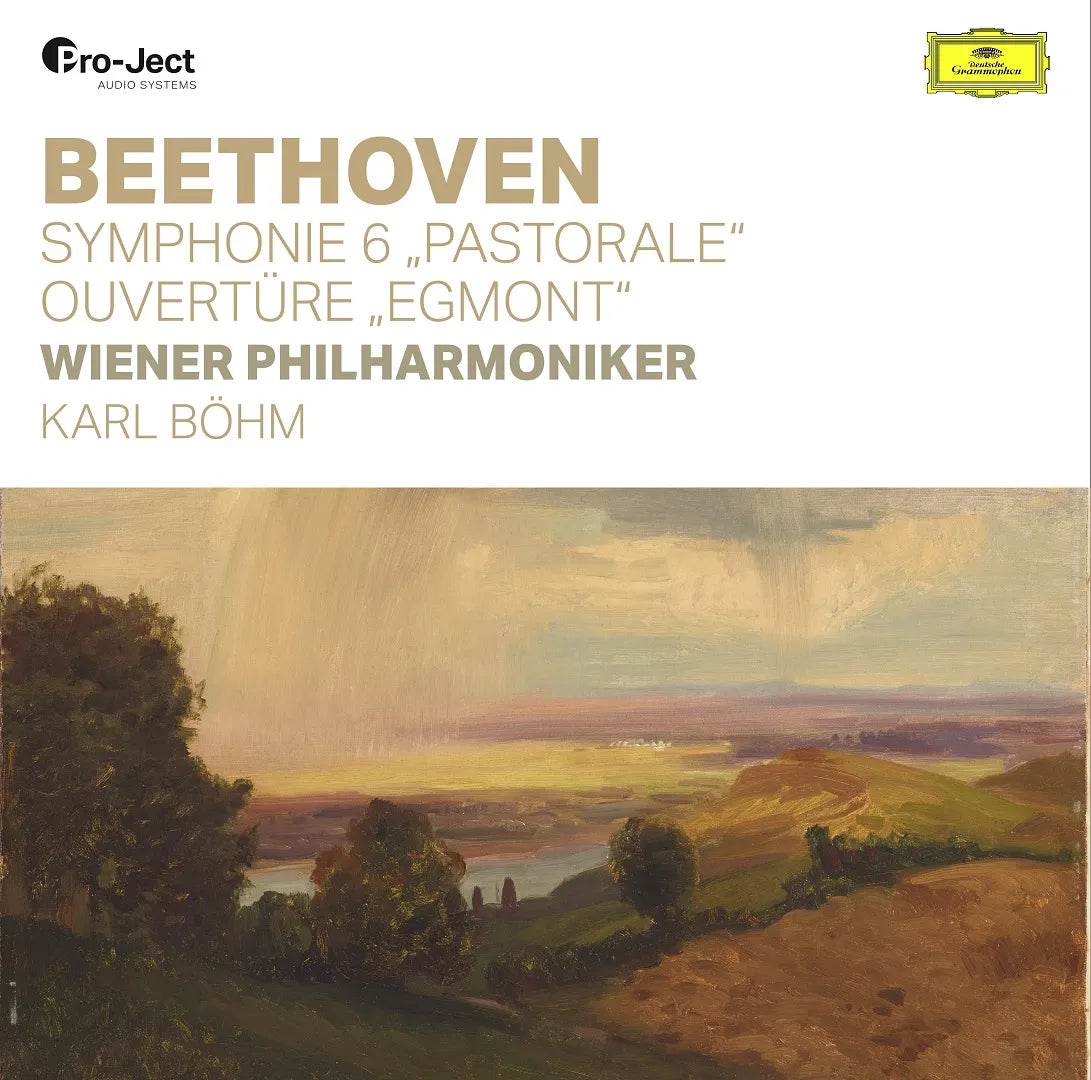
KARL BOHM - BEETHOVEN: Symphony N.6 'Pastoral' - Overture Egmont
KARL BOHM - BEETHOVEN: Symphony N.6 'Pastoral' - Overture Egmont
Pro-Ject Audio Systems LPs
Genere musicale: Classical and Classica
Out of stock
Couldn't load pickup availability
SKU:PJLP1
KARL BOHM - BEETHOVEN: Symphony No.6 'Pastorale' - Egmont Overture ( PJLP1 )
Wiener Philharmoniker & Karl Böhm
A Pro-Ject Records Exclusive-Release!
Setting the Standard in Analogue Purity
Remastered with care and love from the original master tape by Georg Burdicek
This album was produced in collaboration with Pro-Ject Audio Systems to reproduce the original music and audio experience of this famous concert in the Golden Hall of the Vienna Musikverein. Pressed with the utmost precision on high-quality 180g vinyl by Pallas Germany.
In 1803, Beethoven noted in his notebook: "Bubbling brooks, andante molt[o], the wider the brook, the deeper the tone" and sketched the first sketches for the dance rhythm of the third movement. Five years later, he labeled the first three movements as scenes: "Scene: Arrival in the Countryside [and] Effect on the Mood," "Scene by the Brook," and "Scene: Festive Gathering," to which he added, "Even without descriptions, the whole will be perceived more as an expression than as a painting of sound." Finally, he prefaced the symphony with the words, "More expression of feeling than painting." Although the symphony was inspired by impressions of nature (Beethoven called it "Pastoral Symphony, or Recollections of Country Life"), this F major composition is not intended to depict natural events. Rather, the idea of nature itself was poured into the symphony's form, giving it five movements instead of the usual four. Thematically, the work is fundamentally constructed on triads. The opening of the first movement already anticipates the formative material of the following Allegro, which owes its characteristic color not least to the sustained pitches reminiscent of bagpipes and hurdy-gurdy. The "Scene by the Brook," with its onomatopoeic allusions to birdsong, is conceived as an expanded rondo. Whether or not the cuckoo's song struck a chord with Gustav Mahler, a similar song can be found in the opening of his First Symphony.
The third movement, which replaces a scherzo, draws its character from the German dance known as the Deutscher. It is a gruff and assertive Allegro that leads directly to the symphony's dramatic climax: a musical thunderstorm. Here, thunder is represented by sixteenth-note quintets in the cellos and double basses, and raindrops by a sparkling four-note figure in the violins. The finale follows without interruption, returning once again to the tranquil atmosphere of the first movement. Beethoven's return to the rondo concept of this movement in his late String Quartet, Op. 132, is due to the similarity of the subjects: in the "Pastoral" finale, the shepherds express their gratitude for the end of the storm, while in the string quartet, a man previously afflicted by a serious illness gives thanks to God for his recovery.
Karl Böhm, born in Graz in 1894 and died in Salzburg in 1981, holds a special place in the history of the Vienna Philharmonic. In 1967, this doctor of law became the first person to be awarded the title of "honorary conductor" by the orchestra, an honor that has since been bestowed only once in the orchestra's history, to Herbert von Karajan in 1980. Böhm's warmth for the orchestra is evident in the words he spoke during his final appearance with the Philharmonic. It was the final recording session for the film version of Richard Strauss's Electra, which counted Böhm among its favorite conductors: "I have loved the orchestra as a human being ever since I first heard it, at the back of the stalls of the Musikverein, and ever since I first conducted Tristan at the State Opera."
It was the success of this performance of Tristan und Isolde at the Vienna State Opera (where Böhm conducted from 1943–45 and again from 1954–56) that led to his debut concert with the Vienna Philharmonic in April 1933. His last concert was in Japan in 1980. If we add to this his 667 appearances at the Vienna State Opera, Karl Böhm, "General Music Director of Austria," conducted the Vienna Philharmonic 1,430 times. This figure does not even include the sessions for the numerous recordings he made with the orchestra during their 48-year association. These included his highly acclaimed complete recording of Beethoven's symphonies from the early 1870s, along with several overtures, including "Egmont," composed in 1810 for a Viennese performance of Goethe's tragedy of the same name. All these pieces are an eloquent testimony to a musical ideal characterized by precision and naturalness of expression and provide documentary evidence of Böhm's impeccable sense of timing.
Ludwig Van Beethoven
LP 1 - Symphony No. 6 in F-Major, Op. 68 “Pastoral”
Side A
1. Erwachen heiterer Empfindungen bei Ankunft auf dem Lande / Allegro ma non tanto
Side B
2. Scene by Bach / Andate molto mosso
LP 2
Side C
3. Lustiges Zusammensein der Landleute / Allegro
4. Gewitter – Sturm/Allegro
5. Hirtengesang. Frohe und dankbare Gefühle nach dem Sturm / Allegretto
Side D - Overture "Egmont" op. 84
6. Music to Goethe's Tragedy
- Original label: Deutsche Grammophon

-

Spedizioni prodotti fisici
Spedizioni gratuite in Europa (UE), a partire da 4 articoli - Richiedere quatozione per i costi di spedizione per i paesi non UE
-
Consegna prodotti digitali
La consegna dei prodotti digitali avverrà direttamente sul sito e riceverai anche una email con il link per il download dei file.
-
Scrivi una recensione
Qui sopra puoi scrivere una recensione sul prodotto che hai acquistato, saremo felici di conoscere la tua opinione.
