

FLUTE, CELLO & PIANO TRIOS - FortePiano Trio
FLUTE, CELLO & PIANO TRIOS - FortePiano Trio
Velut Luna
Music genre: Classica
In stock
Couldn't load pickup availability
SKU:CVLD242CD
FLUTE, CELLO & PIANO TRIOS (CVLD242)
Composer: Mendelssohn, Weber, Martinu
Performer: FortePiano Trio ( Leonora Armellini, Ludovico Armellini, Tommaso Benciolini)
Available in: HD File, CD
Tracks
FELIX MENDELSSOHN BARTHOLDY
Trio in D minor, Op.49
01 - Molto Allegro Agitato
02 - Andante con moto, Tranquillo
03 - Scherzo, Leggiero e vivace
04 - Finale, Allegro assai appassionato
CARL MARIA VON WEBER
Trio in G minor, Op.63
05 - Allegro moderato
06 - Scherzo, Allegro vivace
07 - Andante espressivo
08 - Finale, Allegro
BOHUSLAV MARTINU
Trio for flute, cello and piano
09 - Poco allegretto
10 - Adagio
11 - Andante, Allegro scherzando
Tommaso Benciolini, flute
Ludovico Armellini, cello
24bit/88.2kHz original live-in-studio recording, Preganziol, April 14th, 2013
Notes
FortePiano Trio
Composed of Tommaso Benciolini on flute and the twins Ludovico and Leonora Armellini on cello and piano respectively, the FortePiano Trio was born from the desire to bring together the diverse and eclectic personalities of three friends in a common musical project with the aim of spreading and expanding the repertoire for this unusual formation. All graduated with honors at a very young age and winners of national and international competitions, they perfected their skills with great masters including Lilya Zilberstein, Pierre-Yves Artaud, Mario Caroli and Giovanni Sollima at some of Europe's most prestigious musical institutions such as the Accademia Nazionale di Santa Cecilia in Rome, the Hochschule für Musik und Theater in Hamburg, the Scuola Universitaria di Musica della Svizzera Italiana in Lugano, and the Ecole Normale de Musique in Paris.
In 2012, the FortePiano Trio began an intense concert activity that leads them to perform regularly in the main Italian cities.
The young ensemble is also committed to commissioning and disseminating new music, and is the dedicatee of the "Trio in due movimenti" by composer Simone Tonin and the "Merry Gentlemen Variations, Trio Fantasia on a Christmas Carol" by composer and conductor Andrea Battistoni, receiving critical and public acclaim at every performance.
"He is the master-trio of the present [...] a masterpiece that will still delight grandchildren and great-grandchildren after many years." This is how Robert Schumann presented Felix Mendelssohn's Trio in D minor Op. 49 for violin, cello, and piano in 1840, just published by Breitkopf & Härtel. A happy creation by the "Mozart of the 20th century – Schumann continues – the clearest musician who first clearly saw and reconciled the contradictions of the era." The English publisher J.J. Ever was also ready to bet on the popularity the work would achieve, with its serene discursiveness to which the elegant embellishments of the piano part added brilliant effects. Ever asked Mendelssohn for an arrangement of the Trio, specifically of the second and third movements, with the flute in place of the violin, to be published as Andante and Rondo (from Op. 49). The author ultimately decided to transcribe the entire work for piano, flute, and cello, not limiting himself to a simple transposition of the violin part. In adapting the original violin part for the flute, Mendelssohn took into account the different sonic peculiarities of the wind instrument and introduced some significant variations (octave transpositions, modifications of rhythmic figurations, and minor adjustments) which constitute a veritable rethinking of the part in function of the altered sonic balance between the three instruments.
In a nineteenth century that largely did not seem to particularly love wind instruments, at least among its major musical protagonists, Carl Maria von Weber instead showed a particular predilection for some of them; clarinet, horn, and bassoon above all, for their evocative sonorities so suitable for representing the "supernatural nature" that serves as the backdrop to his romantic melodramas (Weber also dedicated several concertos to the three instruments). The flute also finds its place in several of the composer's chamber pieces, the most notable of which is the Trio in G minor Op. 63 for flute, cello, and piano, composed between 1818 and 1819.
The agreeably conversational character of the work is evident from the composure of its formal structure in four movements, all adhering to classical models, and in their overall expressive balance. Without sacrificing some more intense romantic color in the outer movements, the Trio maintains a range of "affections" whose measure of reference is given by the carefree dance character of the brief "Scherzo" and the gentle lieder-like melody of the "Andante espressivo" bearing the title Schäfers Klage (The Shepherd's Lament).
Already an unruly and rebellious child prodigy, as well as a talented violinist, the American-naturalized Bohemian Bohuslav Martinu was an artistically free spirit, attentive to the various directions of twentieth-century musical and cultural avant-gardes, which he frequented assiduously during his long stay in Paris (1928-1940), from where he would move to the United States and remain until 1953. In his output, Martinu gives space to the moods of Czech folklore, especially in the rhythmic component which is always strongly highlighted in his works, marked by a general climate of serenity and eclectic pleasure in making music, also evident in the Trio in F major for flute, cello, and piano (1944). The dispassionate and ironic, yet not provocative, aspect of his creativity can be identified in the motor vitality, in his very personal interpretation of tonal syntax, and in the sometimes capricious changeability of expressive moods; stylistic peculiarities that in the Trio find their disciplining element in the classicist formalism of the structures to which the composer deliberately adheres to indulge his underlying lyrical and nostalgic vein, particularly evident in the pensive central "Adagio." The first movement, "Poco Allegretto," and the finale "Allegretto scherzando" (connected to the central tempo by a cadenza, "Andante," for solo flute) share a dry linearity of writing in which the rhythmic sprightliness and the close dialogue between the three instruments, always in perfect balance with each other, are fully evident.
Marco Materassi
Musical Producer: Leopoldo Armellini
Recording, mix and mastering engineer: Marco Lincetto
Editing: Mattia Zanatta
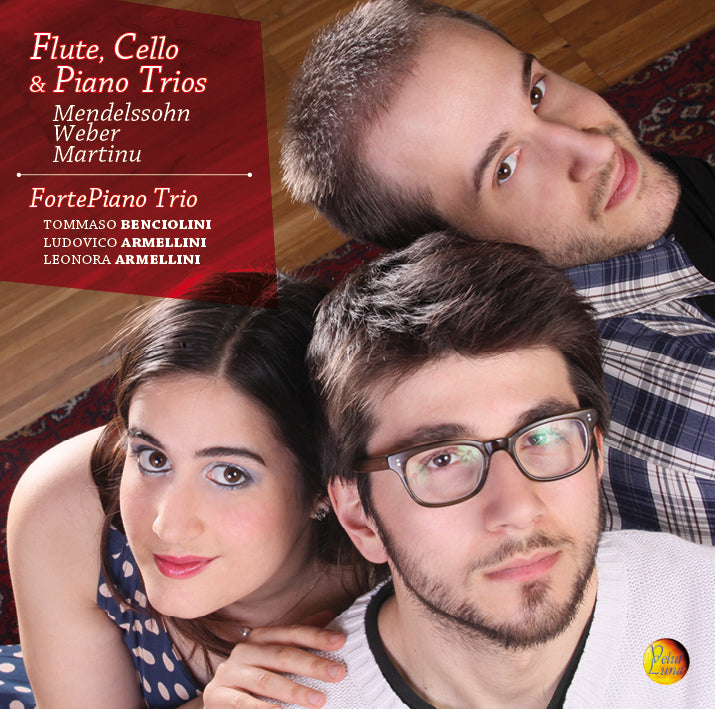
Cover photo by Marco Lincetto

-

Shipping physical products
Free shipping in Europe (EU), for 4 items or more - Request a quote for shipping costs for non-EU countries
-
Digital product delivery
Digital products will be delivered directly on the website and you will also receive an email with a link to download the files.
-
Write a review
Above, you can write a review of the product you purchased; we would be happy to hear your opinion.
