
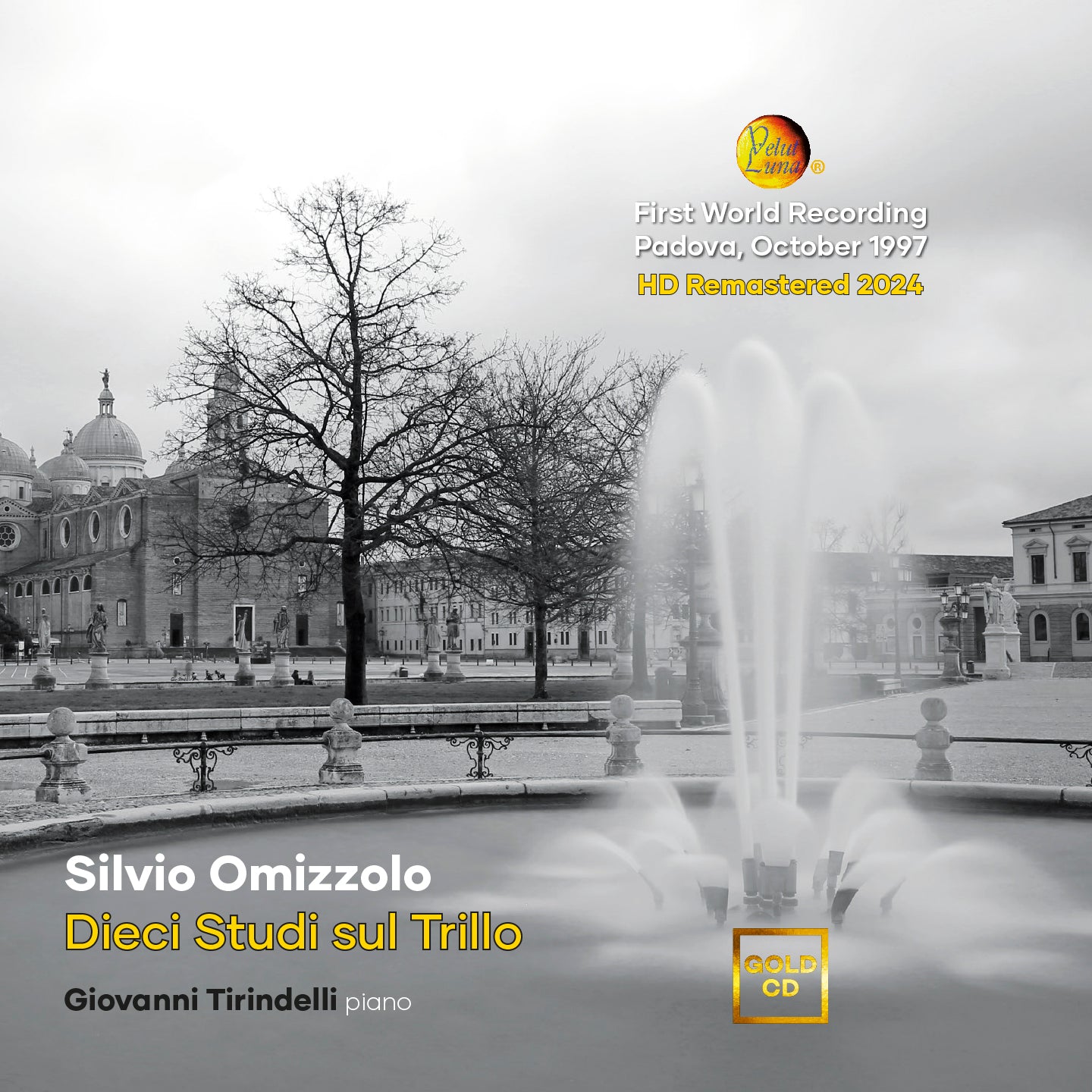
Ten Studies on the Trill - SILVIO OMIZZOLO
Ten Studies on the Trill - SILVIO OMIZZOLO
Velut Luna
Music genre:
In stock
Couldn't load pickup availability
SKU:CVLD380GOLDCD
Ten Studies on the Trill - SILVIO OMIZZOLO (CVLD380)
Giovanni Tirindelli, piano
HD REMASTERED FROM ORIGINAL ANALOG TAPE
Available in: HD File, Gold CD
Volume I
01 - Mazurka: Moderately animated 2:44
02 - Funeral March: Very slow 4:50
03 - Scherzo: Presto. Più tranquillo. Presto 8:09
Volume II
04 - Song without words: Not too slow 4:21
05 - Habanera: Slowly 4:19
06 - Polacca: Moderato maestoso 5:43
Volume III
07 - Barcarola: A little sustained 6:24
08 - Minuet: Moderato, Musetta: Più mosso. Moderato 5:06
09 - Marcetta: Allegro 3:02
10 - Toccata: Vivo (sonorous, with much pedal, almost bells) 6:01
Total Time: 50:46
48kHz / 20bit original recording made at Auditorium Pollini, Padova, on October, 1997
Analog remastering and 88.2kHz / 24bit AD High Resolution Digital Master made at MLStudio, Naquera, Spain, on May 25, 2024
Production: Marco Lincetto for Velut Luna Recording, mix and mastering engineer: Marco Lincetto
Musical producer: Giovanni Tirindelli
Photo: Marco Lincetto
Design and layout: L'Image
Ten Studies on the Trill
Silvio Omizzolo was born in Padua in 1905. A student of Renzo Lorenzoni from 1923, he graduated from the Milan Conservatory in 1927. In the meantime, he obtained his classical high school diploma, then graduated in Law from the University of Ferrara.
For composition he was practically self-taught, although he treasured the encouragement and precious advice of Almerigo Girotto. His first works for piano belong to 1928, followed by numerous works both for the same instrument and for various vocal and instrumental ensembles. In 1943 he won the first prize at the Musicians' Union Competition, followed by numerous important awards, including a third prize at the international "Queen Elisabeth" competition in Brussels (in 1969), with his Concerto for piano and orchestra, the only Italian work selected from among 200 competitors. Many of his compositions have been performed in public and broadcast by RAI.
Alongside his activity as a composer, he had a rich concert career both as a soloist and in chamber ensembles.
From 1933 to 1974 he held a professorship in principal piano at the Pollini Conservatory in Padua, then a state-recognized music institute: he was director of the same institute from 1966 to 1971, contributing decisively to its transformation into a State Conservatory. He died in 1991, at the age of 85.
Of his "10 Studies on the trill", from which the selection for this collection is taken, Silvio Omizzolo wrote: "I wrote the Studies because there was no such work, but, as usual, I didn't want to give them too much importance. The title is weak, sloppy. I could have called them Concert Studies, as they really are."
The analysis and recollection by Wolfango Dalla Vecchia
After his first compositions for piano (Elegia, Sogno, Fantasmi, Preludio e Fuga) which appeared between '28 and '29, Silvio Omizzolo's personality is fully evident in the highly ambitious and prestigious Ten Studies on the Trill, composed in 1936, published by Ricordi in 1939 and performed for the first time by Carlo Vidusso in Milan in 1940.
In their eclectic pianism, these ten studies compose a singular work that stands out clearly from a whole host of similar piano works, for the solid architecture of the whole, which does not indulge in any inspirational randomness, but rigorously concludes a precise design, in which the didactic purpose provides the pretext for the creation of a suite of traditional piano forms, in which the trill, in all its variations, assumes contextual importance not as a decorative or secondary detail, but as a fundamental semantic element, provoking various lyrical states. The themes follow one another rich in verve and always varied; but the deus-ex-machina of every emotion is always this changing and raging trill without interruption, from its subdued and measured appearance in the initial Mazurka, to the dark rolls of the Marcia funebre, to the delicate murmurs of the Canzone senza parole, to the witty exploits of the Marcetta, to the brilliant trills of the Polacca, to the complex ones of the Barcarola and the Minuetto, to the multiple, arduous and astonishing ones of the final Toccata.
A historical and technical note by Marco Lincetto
This album was recorded by me in the distant month of October 1997 and immediately released in December of the same year with my VELUT LUNA label, which was then just a couple of years old (the first edition of '97 had catalog number CVLD009, while today's has CVLD380...). It is undoubtedly one of the most important albums I have ever recorded and produced, first of all because Giovanni Tirindelli and I represent the final links of that princely artistic lineage that starts from Silvio Omizzolo, of whom Giovanni was one of the last pupils, continues with my father Adriano Lincetto, also a pupil of Omizzolo and curiously born in 1936, the year these Ten Studies were composed, of which he would become one of only three great interpreters, along with Carlo Vidusso and Franco Angeleri, up to Giovanni's performance. Throughout my childhood and youth, I lived with my father's long hours of studying this score, in preparation for his many concerts in which he performed it and which, he then decided to play as the last pieces (Mazurka, Funeral March and Toccata) of his last public concert, in October 1979, with Silvio Omizzolo sitting in the front row. These are moments of life in music and for music that I, Giovanni and a few others have touched firsthand, and from which we have drunk and which we can now pass on to posterity. Therefore, this absolute first recording of Omizzolo's studies, in my opinion, puts a kind of tombstone on any other interpretation or recording that may be proposed of this hypnotic, unique and fundamental composition of piano literature of all time. From a technical point of view, it is a very carefully crafted work already at the time, a pure recording made with only two omnidirectional microphones in the wonderful hall of the Auditorium Pollini, conceived and desired by Adriano Lincetto and Wolfango Dalla Vecchia, who in various capacities succeeded each other in the management of the Conservatory that hosts it. And once again, therefore, the intertwining of life is not accidental and has meaning. Thanks to the technology matured over the last 27 years, today I am re-proposing a "remastered" version, as they say, which in reality leaves the original quality unchanged, adding an even better presence, better spatiality and a new great general freshness to the sound. All this is corroborated and best conveyed also by the precious support of the CD made of gold foil.

-

Shipping physical products
Free shipping in Europe (EU), for 4 items or more - Request a quote for shipping costs for non-EU countries
-
Digital product delivery
Digital products will be delivered directly on the website and you will also receive an email with a link to download the files.
-
Write a review
Above, you can write a review of the product you purchased; we would be happy to hear your opinion.
