

DE FORMA SONATA: LISZT,BERG,CHOPIN - GIUNTI
DE FORMA SONATA: LISZT,BERG,CHOPIN - GIUNTI
Velut Luna
Music genre: Classica
In stock
Couldn't load pickup availability
SKU:CVLD224CD
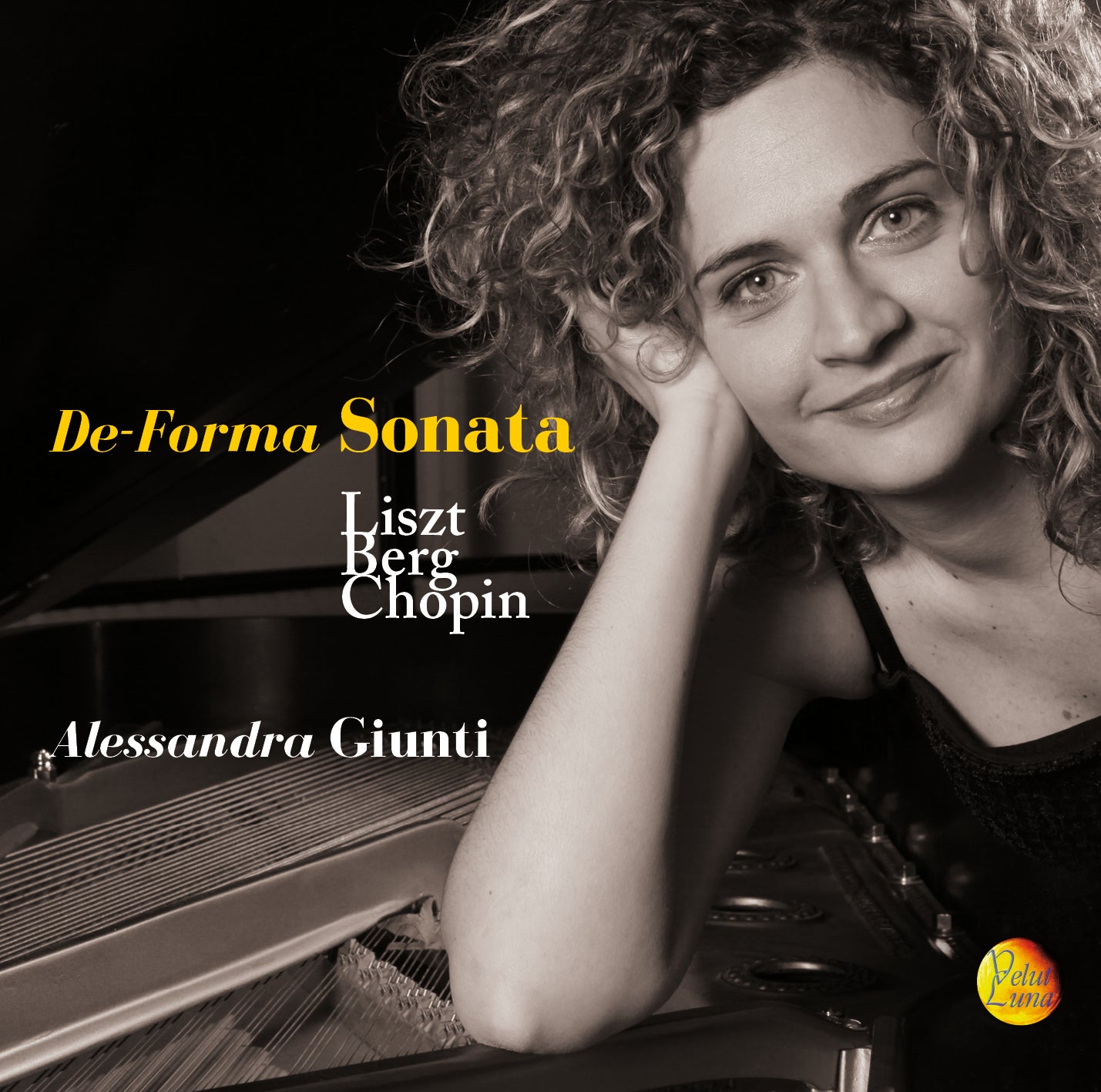
DE FORMA SONATA: LISZT,BERG,CHOPIN (CVLD224)
Composer: LISZT BERG CHOPIN
Performer: ALESSANDRA GIUNTI
Available in: File HD, CD
Production: Velut Luna
Musical producers: Achille Gallo & Alessandra Giunti
Recording Engineer: Marco Lincetto
Editing Engineer: Matteo Costa
Photo: Marco Lincetto
Layout: l’image
Marketing: Francesco Pesavento
Sales Manager: Moreno Danieli & Patrizia Pagiaro
Press Agent: Emanuela Dalla Valle
Tracks
01 - Franz Liszt - Sonata in B minor, S178
02 - Alban Berg - Sonata in B minor, op 1
03 - Fryderyk Chopin - Sonata in B-flat minor, n2, op 35_ Grave Doppio movimento
04 - Fryderyk Chopin - Sonata in B-flat minor, n2, op 35_ Scherzo
05 - Fryderyk Chopin - Sonata in B-flat minor, n2, op 35_ Marche funèbre, Lento
06 - Fryderyk Chopin - Sonata in B-flat minor, n2, op 35_ Finale Presto
Notes
Classical. Orginal compositions by Liszt, Berg, Chopin. Alessandra Giunti grandpiano.
88.2kHz/24bit original live-in-studio recording made at Magister Area Studios, Preganziol, on February 2012.
Composed between 1852 and 1853, published in 1854 by "Breitkopf & Hartel" in Leipzig and dedicated to Robert Schumann, Liszt's Sonata belongs to a period in the composer's creative life when thought clearly prevailed over virtuosity. Never before had the composer conceived such a vast work for the piano. As the creator of the Symphonic Poem, something that decidedly goes against the "enlightened" construction of sonata form, Liszt ventures into a composition taking only minimally into account the formal prerequisites that this type of artistic creation entails. It is a composition written in a single movement that achieves a complete reversal of the genre: the scheme of sonata form is inexorably bent and adapted to new expressive needs, with a formidable work of construction and a fantastic dramatization of all elements of the discourse. From these premises, it is understandable why the work escapes the traditional "exposition-development-recapitulation" sequence, and is articulated according to a cyclic form with the principle of thematic development assimilated to the process of variation. The main indications of the movements are: Lento assai, Allegro energico, Andante sostenuto, Allegro energico, Andante sostenuto, and Lento assai. Given what has been said so far, Liszt's Sonata in B minor is a symphonic poem for piano and at the same time a true encyclopedia of musical romanticism. The only piano piece in Berg's catalog was composed between the summer of 1907 and 1908. Printed in 1910 at the author's expense, it was numbered opus 1 and titled Sonata.
It is in a single movement, as the young musician accepted the advice of Schoenberg, his teacher, not to add others. Despite this, this formal structure appears classical: an exposition (with a repeat), a development, recapitulation, and a brief coda. All constructed with precision, and articulated with remarkable economy of thematic material. But the emotional climate is far from eighteenth-century models: chromaticism - which is juxtaposed with diatonicism - introduces a tension that progressively intensifies, to be reabsorbed only in the finale, after a very dramatic central explosion. Thus, in a rigorous architecture, a passionate sensibility and all the excesses of romantic delirium are expressed. Chopin's Sonata Op. 35 originated around the Funeral March composed in 1837. The first and last movements were sketched between 1838 and 1839, while the Scherzo dates back to late summer 1839, when the idea arose of organizing all the movements into a sonata that would gather around the already well-known Funeral March. It was published in May 1840. The usual structure of the first movement appears rather different from the rigorous conduct prescribed by tradition: the Development, for example, is not the moment to explore all the rhythmic and harmonic possibilities of the themes, as in Beethoven's conception, but the place to enhance the expressiveness of dramatic potential; the Recapitulation is not the natural conclusion of a piece, but the culminating point of greatest creative tension. Scherzo and Funeral March, although presented as ritual moments of the classical sonata, actually represent particular phases of the composition. Thus the very brief conclusive Presto - which appears in the form of a perpetual motion where neither melody nor rhythm are punctuated - is more an evocation of pianistic color entrusted to the two hands playing parallel musical lines. The exceptional character with which Chopin approaches sonata form and the care for artistic form, to the utmost perfectionism, have coined a unique, rare, and precious example of a work of art.

-

Shipping physical products
Free shipping in Europe (EU), for 4 items or more - Request a quote for shipping costs for non-EU countries
-
Digital product delivery
Digital products will be delivered directly on the website and you will also receive an email with a link to download the files.
-
Write a review
Above, you can write a review of the product you purchased; we would be happy to hear your opinion.
