

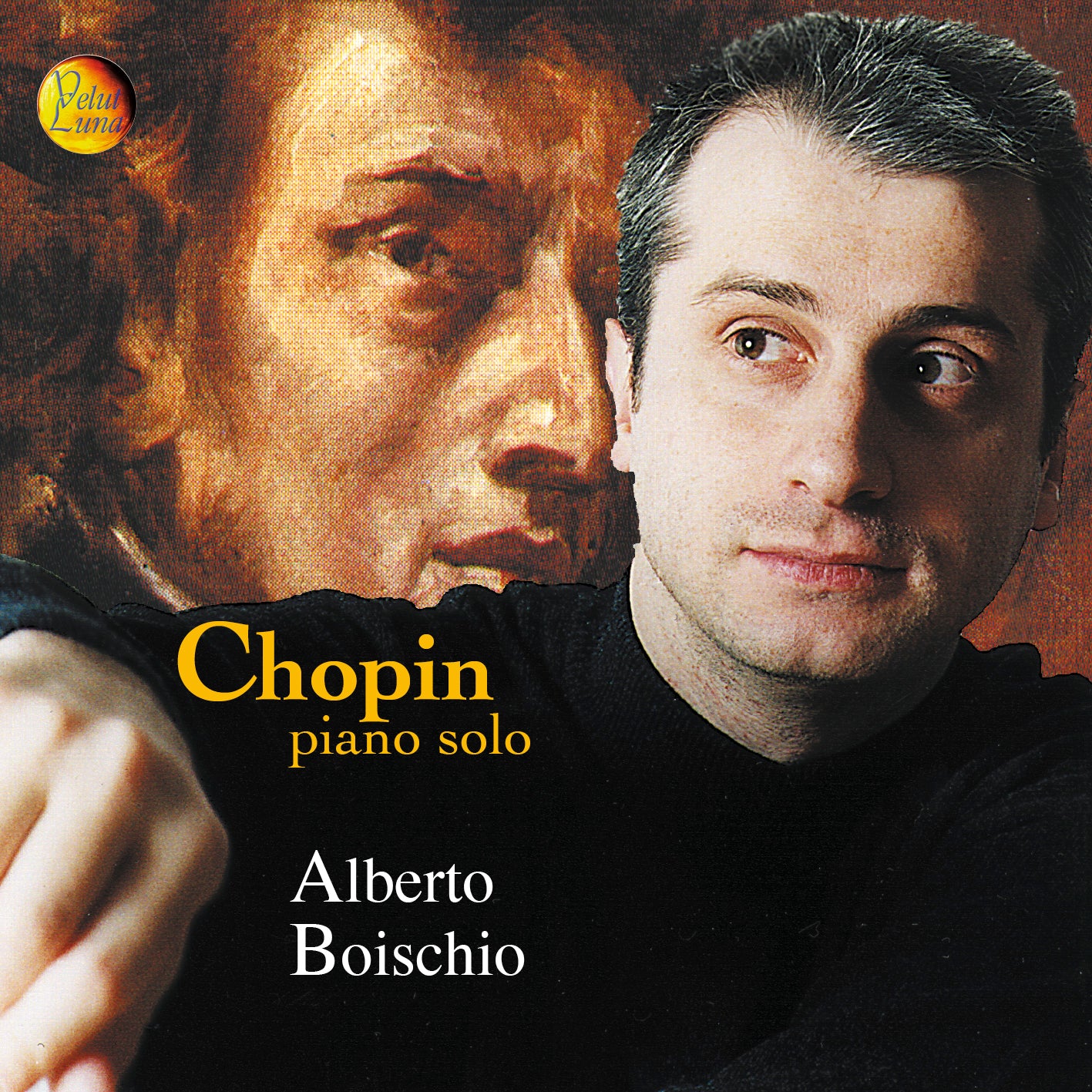
CHOPIN PIANO SOLO - BOISCHIO
CHOPIN PIANO SOLO - BOISCHIO
Velut Luna
Music genre: Classica
In stock
Couldn't load pickup availability
SKU:CVLD216
CHOPIN PIANO SOLO (CVLD216)
Performer: Alberto Boischio
Tracks
1) Ballade in G minor, Op. 23, No.1 (1831) 9’23”
2) Mazurka in G minor, Op. 67, No.2 (1849) 2’09”
3) Mazurka in A minor, Op. 67, No.4 (1846) 3’24”
4) Nocturne in F sharp minor, Op. 48, No.2 (1842) 7’49”
5) Nocturne in C sharp minor / Op. Posth. (1830) 3’47”
Sonata in B minor, Op. 58 (1844)
6) - Allegro maestoso 9’11”
7) - Scherzo, molto vivace 2’37”
8) - Largo 8’13”
9) - Presto non tanto, agitato 5’14”
Total duration 51’56
Notes
One hundred and fifty years after his death, is there still something to discover about Chopin? As for his biography, I would say no: even the clouds that hung over his ancestors have been swept away by meticulous archive research, and his father's earthly story has been entirely reconstructed. Unless unknown memories, locked away in the archives of families close to Chopin, suddenly appear, it seems unlikely that the still obscure aspects of his life can be illuminated. His relationships with contemporaries, and especially with George Sand, have been thoroughly investigated, finally returning, after more than a century of fables, to what the documents reveal. In my opinion, critical studies still have three major lines of inquiry open: Technique, the Reconciliation of Microcosm and Macrocosm, and the Feeling of Homeland.
Chopin's revolutionary technique developed in conjunction with a significant evolution in piano construction: between approximately 1820 and 1830, the instrument acquired a frame with metal plates and tension bars that reinforced the traditional wooden frame, thicker and more tensioned strings, more robust hammers covered in felt instead of leather, and a heavier action. Classical technique, codified by Muzio Clementi, did not allow the pianist to develop the full sonic potential of the Romantic piano, and attempts to preserve it by adapting it to the instrument's changed characteristics were unsuccessful. Chopin, however, created a technique that rejected certain fundamental postulates of classical tradition (such as the equality of fingers and action limited to fingers and hand) and discovered previously unknown possibilities of touch.
Some conservative critics of Chopin's time considered the Études Op. 10 unplayable, and indeed they were if approached with Clementi's technique. But in the Études Op. 10 and Op. 25, a new and very broad technique was invented, which represented a definitive acquisition for the piano. Subsequently, in the Trois Nouvelles Études, Chopin addressed, so to speak, the birth of sound on the piano, that is, the boundary between sound and silence, opening up a field that would be thoroughly explored fifty years later by the French symbolists. Now, concerning Chopin's technique, studied from the texts and pianos he was familiar with, there is still much to be said, in my opinion.
The most complex form created by classicism is the sonata, which in its most typical moments brings together four different forms: the two-themed and three-part allegro, the two-themed song, the scherzo with trio, and the rondo. This grand form stands as an insurmountable bulwark before composers who appeared on the scene around 1830.
Schubert, who died in 1828, was already considered a master of small forms throughout the century, and Romantic composers tended to use small forms and to take up and develop, independently of each other, the forms of the classical sonata: for example, Chopin's ballad derives from the two-themed and three-part allegro, and Chopin's scherzo derives from Beethoven's "scherzo with trio."
Another example of the development of a traditional form, the two-themed one, is found in some nocturnes, which expand John Field's salon dimension to a poetic scale and meaning. Chopin also tackles, albeit by exception, the grand classical form; but like Schumann, he organizes small forms into cycles, creating the polyptych. In this sense, certain groups of mazurkas and waltzes are to be considered, but above all the Preludes Op. 28, in which the aphoristic form, the three-part monothematic form, and the song form are inserted into a complex and rigidly pre-structured scheme. Many studies have been made on the Preludes, even recently; but it does not seem to me that the "secret," the enigma of this absolute masterpiece, has been revealed.
The third crucial point in Chopin's poetics concerns his non-belonging to the Central European culture that had dominated the field of piano literature during the Classical era. The son of a Polish mother and a Lorrainese father who moved to Poland at a very young age, Chopin spoke Polish, was culturally formed in Warsaw, and was the first composer to achieve international fame by systematically using stylistic elements belonging to the musical tradition of his people, which were grafted onto stylistic elements of the lingua franca, the European "koinè."
The exotic had already appeared in Central European music for some time. But for Chopin, the exotic is not a picturesque element: he does not occasionally sample the exotic; he IS the exotic, and the culture of his land invests European structures, transforming them. Already in the Scherzo Op. 20, a musical scale characteristic of Poland is contrasted with European harmony: this creates an accord that would be debated by theorists throughout the century.
During his years in Paris, Chopin would constantly return to this, we might say, unusual chemical reaction; and in this way, instead of creating national opera according to the intentions of the musicians who had sympathized with the Kosciuszko uprising in 1794 and the 1830-31 insurrection, he would profoundly influence the course of Central European music until Decadence. And here too, despite the efforts of biographers and critics, something obscure remains.
What will 1999 bring us? Some novelty or a lazy re-flowering of old tales?
Piero Rattalino
The recording was made in Schio at the Church of San Francesco on September 24, 25, 26, 1998, using for the first time in Italy the new high-density digital technology 24 bit / 96 Khz.
Production: Velut Luna
Executive producer: Marco Lincetto
Musical producer: Maria Grazia Bambini
Recording & Mastering engineer: Marco Lincetto
Editing engineer: Fabio Framba
Design: l’image
Photo: Ilenco Tracmot
Marketing: Francesco Pesavento
Sales Manager: Moreno Danieli & Patrizia Pagiaro
Press Agent: Emanuela Dalla Valle
World Wide Contacts: Cristiana Dalla Valle

-

Shipping physical products
Free shipping in Europe (EU), for 4 items or more - Request a quote for shipping costs for non-EU countries
-
Digital product delivery
Digital products will be delivered directly on the website and you will also receive an email with a link to download the files.
-
Write a review
Above, you can write a review of the product you purchased; we would be happy to hear your opinion.
