
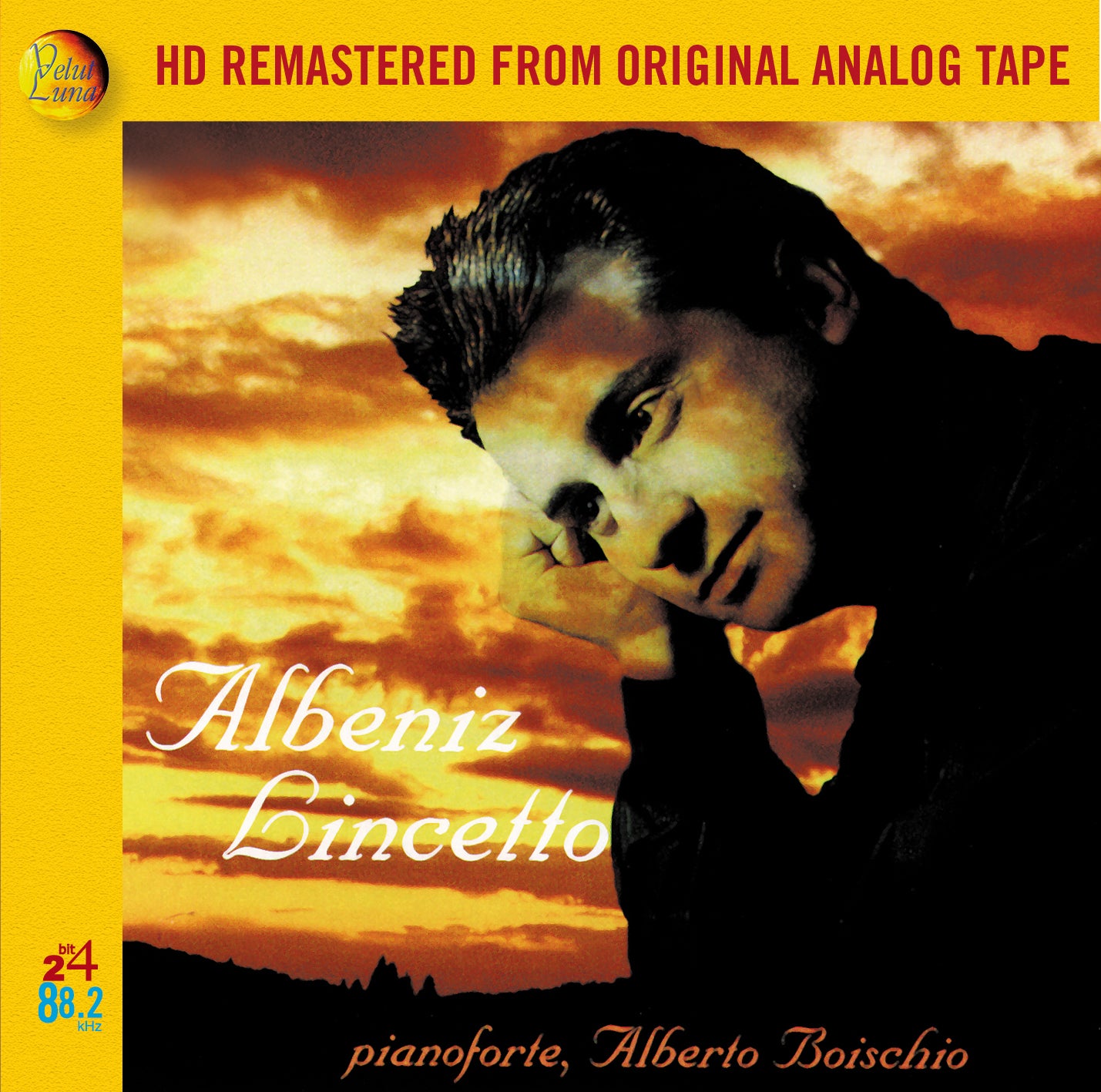
ALBENIZ, LINCETTO: PIANO SOLO
ALBENIZ, LINCETTO: PIANO SOLO
Velut Luna
Music genre:
In stock
Couldn't load pickup availability
SKU:CVLD256
ALBENIZ, LINCETTO: PIANO SOLO (CVLD256)
HD REMASTERED FROM ORIGINAL ANALOG TAPE
ISAAC ALBENIZ
Recuerdos de viaje
01 - En el mar, 5:52
02 - Leyenda, Barcarole, 4:34
03 - Alborada, 4:53
04 - En la Alhambra, 3:53
05 - Puerta de tierra, 3:38
06 - Rumores de la Caleta, 3:25
07 - En la playa, 5:17
ADRIANO LINCETTO
Schizzi per pianoforte (1989)
08 - Preludio, Lento espressivo, 2:17
09 - Notturno, Andante sereno, 2:28
10 - Lento espressivo, 3:49
11 - Allegramente scanzonato, 1:02
Tot. Time: 41:12
The recording was made using the 1/4” two tracks master Teac 2-B RTR, at 38 cm/sec. on August 1997 at Taio Public Auditorium, sheltered between the refined and snug silences of the Trento’s Alps. HD digital remastering by Marco Lincetto was made at Velut Luna Studio, in Casalserugo, on June 11, 2014, using Velut Luna Analog Console and stereo Ad converter Prism Sound Ad-2 Dream set at 24bit/88.2kHz
Production: Velut Luna
Executive Producer: Marco Lincetto
Musical producers: Marco Lincetto
Recording, mix and mastering engineer: Marco Lincetto
Photos: Marco Lincetto
Design and layout: L’Image
Sales manager: Patrizia Pagiaro
Isaac Albeniz
An excellent Catalonian pianist, Isaac Albeniz had quite a lively life. After studying piano with Marmontel at the Paris Conservatoire and with Mendizabal at the Madrid Conservatoire, he ran away from home to embark on a concert career as he was still very young. Travelling in many countries such as South America, the United States, England and Germany, he was able to experience the most varied experiences. Finally, in 1878, he was able to fulfill his dream of becoming a pupil of Liszt, and so followed him to Rome and Budapest. From the moment he met the famous virtuoso and composer, Albeniz became very interested in composition; the first compositions clearly influenced by Lisztian poetics belong to these years. In the decade between 1880 and 1892 he devoted himself to teaching, while maintaining his concert activity and expanding his recital repertoire with his own compositions. In 1892 he was in London, where he could benefit from the financial support of the banker Francis-Money Couts. He settled in Paris from 1893 and there, in full maturity, his talent as a composer finally managed to express itself (Iberia, his probably best known and most important composition, dates from this period). The friendship and closeness with the best personalities of the French musical world of the time, evidently exerted a strong influence on Albeniz: Faurè, Debussy, Dukas, Chausson. Unfortunately, much of his work has been lost. Yet many compositions – mainly composed for his instrument, the piano – still remain unpublished or unrecognized. Curiously, in the popular imagination Albeniz’s name is often united with the guitar; this is due to his Spanish origin, but, above all, to a fortunate series of his pieces transcriptions for the six-string instrument, made by famous guitarists. The set of compositions proposed in this CD is, in the opinion of the writer, particularly significant and exemplary of Albeniz's poetics. The evocative and strongly descriptive tones allow us to significantly unveil the author's many life experiences.
Adriano Lincetto
Maestro Adriano Lincetto - the title is not underlined by chance, as we will see later - was born in Padua on 7 October 1936, and died there in tragic circumstances on 24 April 1996. During these sixty years, he gained great experience in music, which, from his early childhood was his main life companion. Despite his humble origins, his iron will (he worked during the day as a messenger to pay for his piano lessons) and his true natural talent allowed him to brilliantly graduate in just seven years with full marks and honours at the Padua Conservatory of Music under the guidance of Maestro Silvio Omizzolo. His reserved and intimately modest character did not allow him to develop the concert career that in the sixties his talent could have offered him: in fact, despite successful tours as a soloist and in chamber ensembles - not only in Italy but especially in Switzerland and France (we mention some acclaimed radio recordings for ORTF, for the French National Radio and for Swiss Radio) - in the mid-seventies he retired from the scene to dedicate himself to teaching and composition. His collaborations with some famous opera singers open another - and in some ways unresolved - important chapter: we mention above all Lucìa Valentini Terrani, whom he discovered and launched towards the worldwide success that everyone knows, and the baritone Antonìo Salvadori. Once again, in 1972, his excessive modesty and perhaps his excessive attachment to his roots led him to give up the role of substitute director and singer trainer that had been offered to him by the new managers of the prestigious Metropolitan Theatre in New York, which was then in a phase of administrative reorganization after a period of crisis: it is curious to recall how it happened that, after his refusal, a young American talent, James Levine, was chosen, with the results that everyone knows. For the great love he had for music, in its most intimate and familiar sense, he divided his life into two main activities: the public one, teaching (he was a professor of piano at "his" Conservatory in Padua from 1966 until his death) and the other, intimately private, composition. Lincetto wrote above all for himself, and more often for his musician friends, certainly not for popular acclaim, money and rich prizes. This modus operandi, a mirror of his true and pure artistic nature, allowed him to "... emerge from the parody of the so-called artistic world - in turn a grotesque and lethal parody of what is generally understood as the world - without caring about any suggestion, imposition and criterion that came from that parody of art. His salvation, and that of those who listen to his music, lies in the balance in which he lived and composed, beyond old and new things...", as the famous Romanian philosopher and musicologist Radu Lidjienko wrote about him some time ago. Adriano Lincetto has really written a lot of music for orchestra, soloists, choir, the most diverse musical assemblies and for various instruments such as the mandolin and the "Alpine horn"; on the contrary, he has hardly written for solo piano. In addition to the composition of this recording, we also mention "I Momenti Musicali" and some other minor composition powerfully conditioned by Chopínian poetics, composed in his youth and entirely dedicated to his wife, at the time his fiancée.
Alberto Boischío
Alberto Boischio is an old but young pianist. He has dedicated his entire life to date to the piano, without forgetting his family, his wife and, for a year, his little son Matteo. Yet the piano represents his whole life and we hope that this continues to be the case, because of the unconditional opinion we have of his talent: beyond any useless chronicler's list of awards, titles and whatever else today's "intelligentsia", the aristocracy of the music-world seems to demand to grant great artists a licence.

-

Shipping physical products
Free shipping in Europe (EU), for 4 items or more - Request a quote for shipping costs for non-EU countries
-
Digital product delivery
Digital products will be delivered directly on the website and you will also receive an email with a link to download the files.
-
Write a review
Above, you can write a review of the product you purchased; we would be happy to hear your opinion.
